
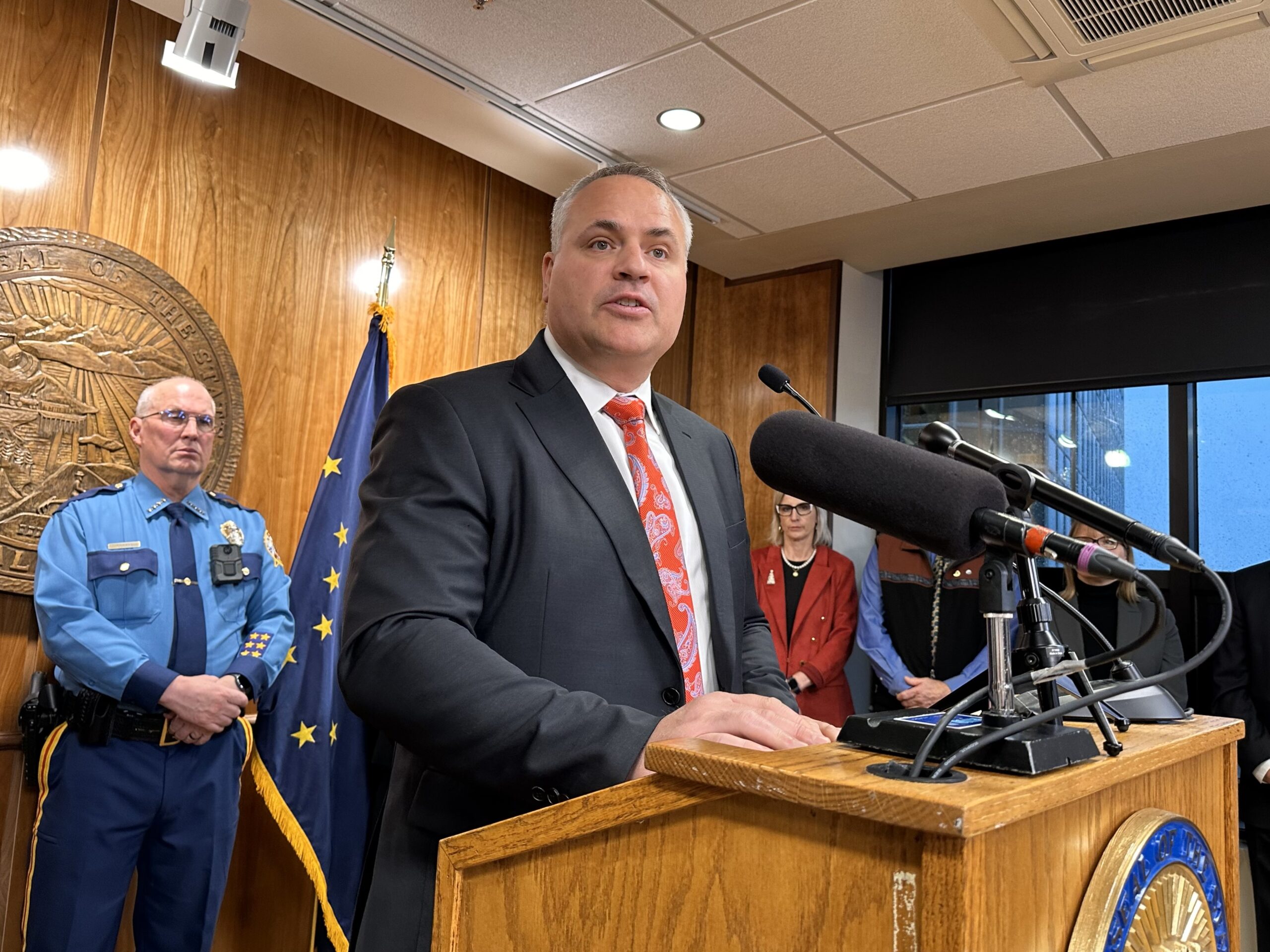
Update: Alaska elections officials on Monday disqualified Treg Taylor, a Republican candidate for governor, from appearing on the November general election ballot.
Read more Mayor says Haines is ‘bleeding young families’ as childcare options get even scarcer
—
Original story:
Alaska’s campaign finance watchdog has recommended against certifying former Attorney General Treg Taylor’s candidacy for governor.
The Alaska Public Offices Commission found that Taylor failed to complete a financial disclosure form as required by state law, even after months of requests to do so by commission staff.
Taylor reported more than $1 million in rental income but did not disclose the full names of his tenants, despite a requirement to do so.
Under Alaska’s election laws, the top four finishers in the primary are set to advance to the general election, regardless of party affiliation.
Taylor, a Republican, finished fifth in Alaska’s gubernatorial primary with 7.4% of votes, based on ballotscounted as of Friday. But the second-place finisher in the primary, Democrat Tom Begich, dropped out of the race Friday, elevating Taylor on to the ballot.
Taylor said in a written statement on Friday that he chose to withhold his tenants’ last names “to protect their privacy.”
It’s been a year since Taylor was first ordered by the Alaska Public Offices Commission to remedy his financial report, after failing to report the names of dozens of tenants. Taylor and his wife in 2023 bought a prominent apartment building in downtown Anchorage while Taylor was serving as the state’s attorney general.
Alaska law requires all public officials and candidates to annually disclose their sources of all income above $1,000.
Taylor said he should not be asked to provide the identity of his tenants because the statute does not specify he disclose the “full name” of each funding source.
Other candidates and public officials in Alaska regularly share the full names of their tenants, including some real estate developers who share lists of hundreds of tenants by their full name.
But Taylor said his tenants and contracts “have been harassed, and in one case threatened with a gun.”
“We made the decision to file like this after the gun incident — and informed APOC,” he said.
Taylor said he offered to the Public Offices Commission to provide the names of his tenants “privately” to the commission while keeping them hidden from the public.
“That offer stands,” he said on Friday.
After proceedings before the commission in September 2025, the commission ordered Taylor to disclose his tenant list in an electronic form.But when he filed his annual report on June 1, it lacked the list of tenants. On July 21, commission staff issued a “notice of deficiency” to Taylor.
In response, Taylor on July 27 uploaded a list of tenants that included only their first name and last name initial, “which does not appear to substantially comply with the requirement to identify his tenants as sources of income,” according to the commission report.
Commission staff informed Taylor that if he sought to withhold the full names of his tenants, “he was ordered to formulate his position in writing for Commission review.” Taylor did not submit a position statement, commission staff wrote.
Read more Man with plan to visit every National Park site hits major milestone in Sitka
Despite multiple notifications from the commission earlier this month, Taylor did not appear during a hearing held Wednesday regarding his financial disclosure. His wife, Jodi Taylor, attended the hearing instead.
Jodi Taylor asked commission staff to delay the review of her husband’s financial disclosure to a later date. When commissioners requested that Jodi Taylor answer questions on her husband’s behalf, she said, “Well, my husband’s not here, and he told me not to.”
Jodi Taylor then agreed to answer questions, and repeated her concerns about threats faced the couple’s tenants.
“We’ve had people on every property we own come and talk to contractors and tenants to pester them,” Jodi Taylor said.
Commissioners asked whether the threats and approaches were because of Taylor’s position.
“They have all been politically motivated,” Jodi Taylor responded.
Earlier this week, the commission recommended that Lt. Gov. Nancy Dahlstrom, who oversees Alaska elections, “not certify Mr. Taylor’s nomination for the office of governor.”
The Division of Elections and the Alaska Department of Law did not immediately respond to questions about whether they planned to accept the commission’s recommendation.
This is not the only time that Taylor has skirted Alaska’s campaign laws. Ahead of the Aug. 18 primary, he gave his own campaign $300,000, well above a limit established in state law for candidates’ contributions to their own accounts in the month leading up to an election.
The Public Offices Commission candidates earlier this year that July 17 was the deadline for making contributions or loans exceeding $5,000 to their own campaigns ahead of the primary. Taylor said that law was unconstitutional, though it has not been challenged in court.
Former Attorney General Bruce Botelho agreed that the statute likely would not withstand a legal challenge. “But it hasn’t been held by any court to that effect,” he said.
“An attorney general has no more standing to declare a statute unconstitutional than any other citizen,” said Botelho, a Democrat. “I would think the more proper course would have been for him to openly challenge the regulation before moving ahead with the expenditure.”
If Taylor’s candidacy is rejected, the sixth-place finisher in the governor’s race could move on to the ballot. That’s Republican former labor commissioner Click Bishop.
The top four candidates are Democratic former lawmaker Jonathan Kreiss-Tomkins; Democratic former lawmaker Begich, who withdrew; Republican businesswoman Bernadette Wilson; and Republican former Anchorage mayor Dave Bronson.
The Division of Elections is expected to certify the primary election results Monday.
The Public Offices Commission also recommended that two other candidates who appeared on the recent primary ballot be disqualified from running for office due to improper financial disclosures.
Read more Paperwork, lines, hours on hold: There’s a ‘Time Tax’ on Americans who need help most