
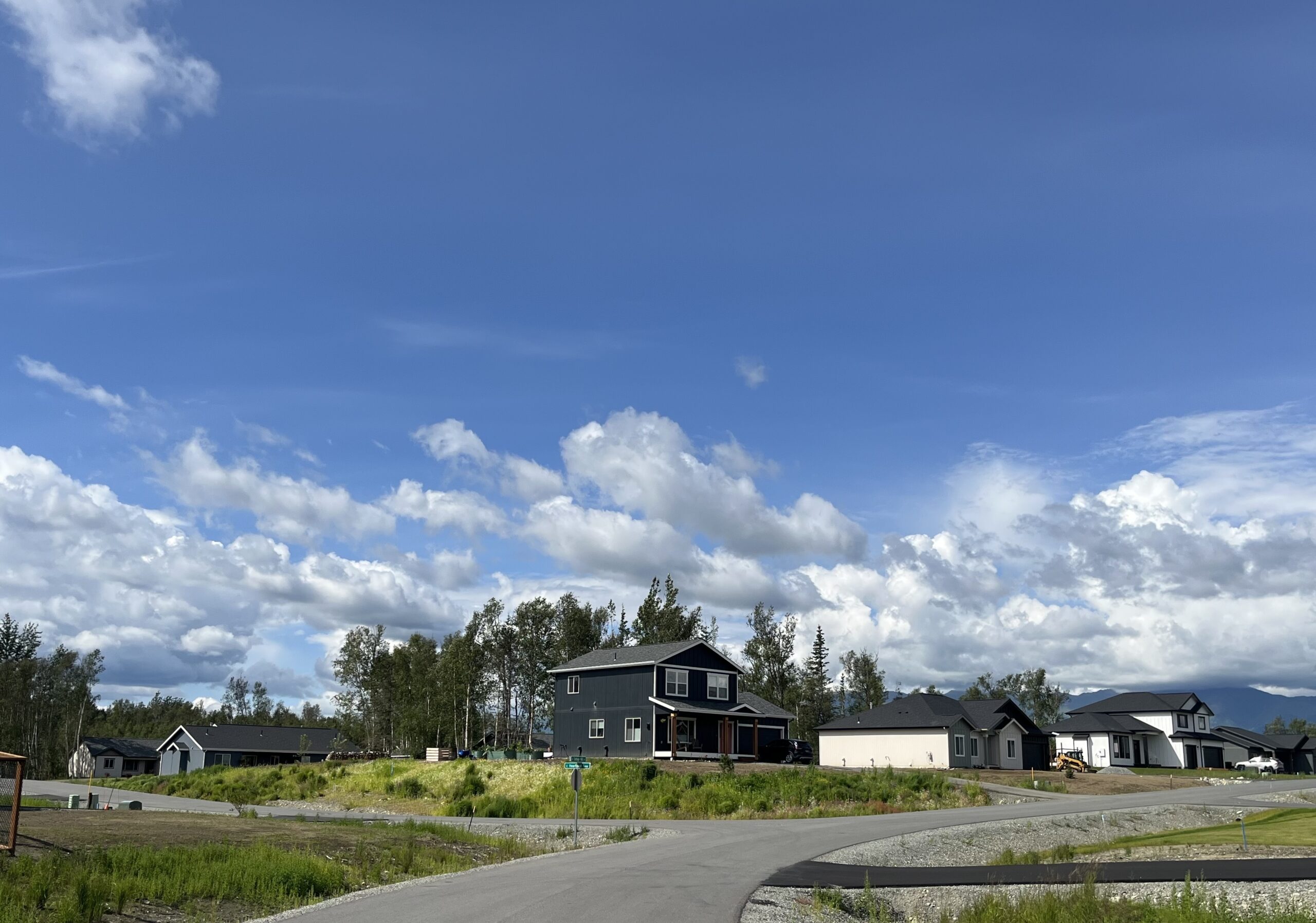
Max Sumner pulled his pickup into a brand new subdivision just east of Palmer. Houses of varying shapes, styles and colors were smattered among rolling hills. Just a few are still under construction.
Read more Anchorage Assembly votes to review members’ spending account use
Developers broke ground on South Village a couple years ago, Sumner said.
“It’s pretty fast,” he said. “Go ask an Anchorage developer how long it would take to create a 40 lot subdivision.”
Sumner stopped his truck by the welcome sign and counted the lots on the map of South Village. There were actually closer to 60. And most of the houses are already occupied, he said. Across the road, in the North Village subdivision, lots are cleared, and houses are starting to go up.
Sumner is a developer, and a member of the Mat-Su Assembly. The subdivisions aren’t his projects, but he’s been watching them progress.
Affordable housing is in short supply nearly everywhere in Alaska. But when it comes to new home construction, the Mat-Su Borough is ahead of everywhere else. People are moving there faster than anywhere else in the state, and homes are going up all over the place to accommodate them. State data shows three times as many homes are built each year in the Mat-Su than in Anchorage, where a housing shortage prompted Mayor Suzanne LaFrance to pledge to bring 10 thousand homes onto the market in the next decade. So why is construction so much faster in the Mat-Su?
A challenge to build in Anchorage
It turns out, it depends on who you ask. But people mostly agree that Anchorage has some real challenges. Bob Doehl, head of Anchorage’s Community and Economic Development department, said the main reason is there’s a shortage of good land in the Anchorage Bowl.
“It’s in smaller parcels than many would like to live on or develop, or it’s too steep, or it has drainage issues,” he said.
According to Doehl, one way to use the limited land efficiently is to increase housing density. The city has been making strides, he said: In 2023, Anchorage relaxed rules for accessory dwelling units, known as tiny homes, or in-law apartments, on residential properties. In 2024 the Anchorage Assembly changed the city’s zoning rules to allow for the construction of duplexes in every residential district in the Anchorage Bowl. But Doehl said it’s important to consider the city’s land use plan, as well as the desires of community members, when considering zoning changes that would increase density. Last year, the mayor’s office put a controversial zoning proposal meant to increase density on hold. The Anchorage Assembly will vote on a similar proposal in September.
Another part of the problem is the ground in the Anchorage Bowl. Both Doehl and developers say the city’s swampy and silty soil is hard to build on. Mat-Su has enviable gravel, which makes it cheaper and easier to build.
Doehl said development often doesn’t pencil out in Anchorage because the land is more expensive. He said that’s because the city is home to many of the major employers in the region, and typically the closer a property is to jobs, the more expensive it is.
The disagreement
And then there’s the issue of regulations.
In the Anchorage Bowl, builders have to follow a lot of rules, much of it in line with international building code and some of it specific to environmental factors in the city, like the prevalence of earthquakes. Developers need to get permits and have their work inspected. But for most of the Mat-Su there are far fewer regulations when it comes to building. In some places, the only permit required is for the driveway.
The role of regulation is where people really start to disagree. Doehl doesn’t think the regulations have much of an impact on housing availability.
Besides, the rules are important, he said. They keep people safe.
“We make sure your house isn’t going to fall apart in an earthquake,” he said. “We look at snow load, we look at winds, and those standards there, the people of Anchorage have decided they prefer them, and frankly, I do too, living here.”
Read more Scams in the U.S. are at a record high. Yet most victims get no help.
The lack of regulation in the Mat-Su has real consequences, Doehl said. Take the 2018 earthquake. by the Earthquake Engineering Research Institutes shows that the damage rate in areas north of the city with less regulation was five times higher than in Anchorage Bowl, he said.
But Mat-Su developer Max Sumner said homes in the Mat-Su are well built. He said that’s because developers know that nobody’s going to be able to get a loan to buy the house if it’s not built to international standards.
“Everyone says that they need more housing, they need more affordable housing, but then they have policies that are antithetical to housing,” he said.
The lack of regulation in the Mat-Su means houses can go up fast, Sumner said. When someone pays him to build a house, he can start right away. Time is money in construction, he said, and regulations in Anchorage just make things more expensive.
“If you just got rid of that entire building department, what would be worse off?” Sumner said. “I mean, more houses would certainly get built.”
“A seven-headed snake”
That suggestion is a little extreme, according to Anchorage developer Andre Spinelli. He’s been in the industry for decades, and is chair of the Anchorage Planning and Zoning Commission. He’s in favor of regulation, he said, but the problem is municipal permits and inspections can take forever.
“How much time are we wasting collectively on this same nonsense?” he said.
Spinelli said there are endless delays because planning department employees don’t agree on code, they don’t understand code, or don’t properly explain their complaints to developers.
“It’s like a seven-headed snake, where you’ve got to get pretty active to beat it back, because every time you cut one thing back, a new thing pops up,” he said.
There have been improvements lately, he said. Over the last two years the municipality worked with a team of engineers and architects to review and suggest changes to city code. At least city policy makers and officials are all working in the same direction, he said.
Bob Doehl said yes, they have ups and downs in the permitting office, but the current staff are some of the best they’ve ever had. There were more residential building permits issued by August of 2026 than in the whole of 2025. In fact, he said, things are going so well that he recently got a congratulatory email from none other than Andre Spinelli.
“The text of it says, ‘Wow, these permits were submitted on Monday and issued today for three houses, i.e. two days later,” he read out loud, over the phone.
Spinelli said yes, he was indeed thrilled. But most permits do not come in two days. They come in 20, 40, or 60 days. It’s proof the department can do it, he said, it just doesn’t happen very often.
Read more Congress averts a government shutdown ahead of the midterms