
Jean Larson-Rein and her golden retriever, Minto, circled around small boxes in the parking lot of the Sitka Fire Department in early September.
Read more Trump slams the Supreme Court for rejecting his push to restrict mail ballots
“We’re looking for bones,” Larson-Rein said. “Minto, bones.”
It was a training exercise to see if Minto could pick out the package with human remains. He paraded around for a bit before he dove at one of the boxes with his nose.
“Yes! Good job! Good job!” Larson-Rein encouraged.
Larson-Rein and Minto traveled from Juneau for Paws Across Alaska, a weekend-long K-9 search and rescue conference. The gathering was put together by Karen Royce with Sitka Search and Rescue’s K-9 team.
“We’ve done this before with just Southeast dogs, but this time we wanted to do dogs all over the state of Alaska,” Royce said. “Dog teams are here from Fairbanks and Kodiak and Wrangell, Anchorage, Juneau and Sitka.”
Search and rescue teams sniffed out buildings and worked along docks and shorelines. They also went over how to decontaminate their dogs and get into baskets the U.S. Coast Guard uses during their rescues.
The main focus of the weekend was learning by doing. And the four-legged friends were put to the test.
Two volunteers were staged as lost berry pickers somewhere in the woods off of Katlian Bay Road.
“They are not back yet,” Royce said, as she laid out the details of a mock search and rescue, also known as SAR. “The family is very concerned and reporting them overdue.”
The teams went over descriptions of who they were looking for. They grabbed their gear — neon vests, bear spray and walkie talkies — and set off in their cars.
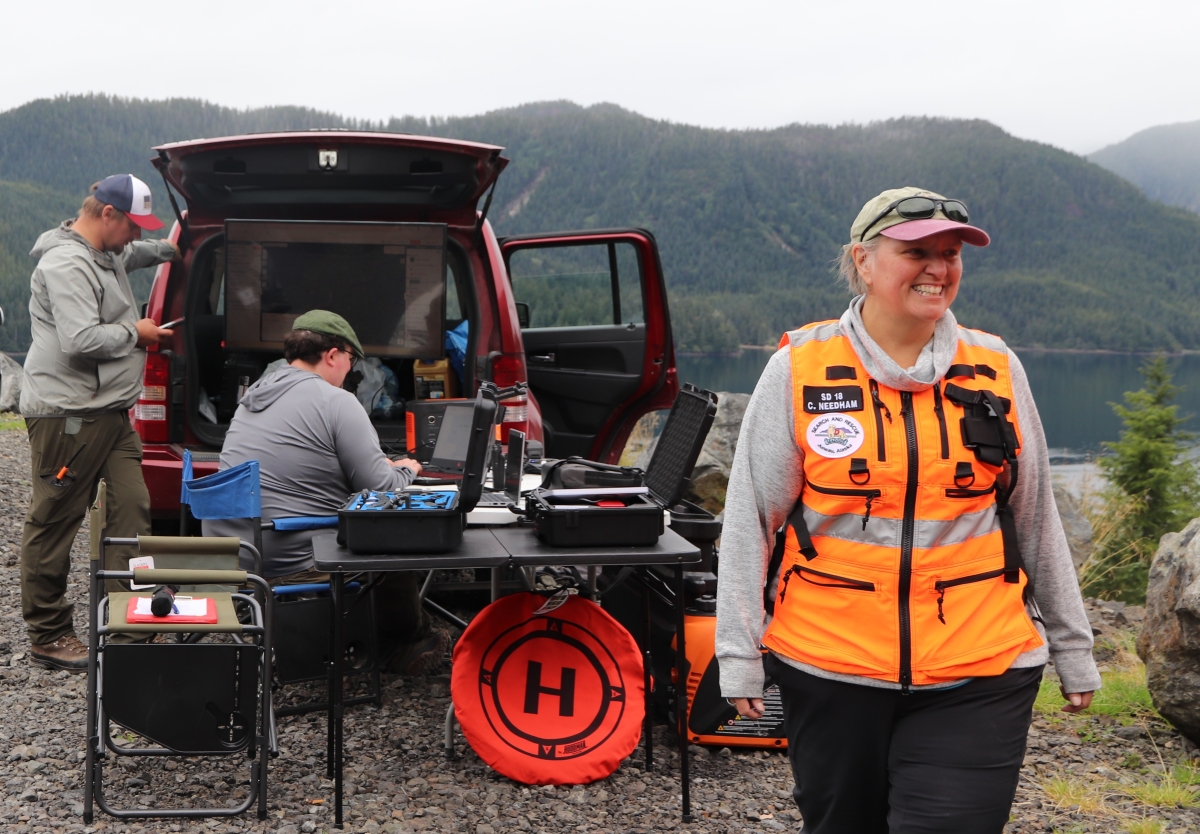
“Who wants to run from the top coming down?,” asked Cathy Needham, the mock operation’s designated leader. She split the group into six teams — each with one or two dogs — to cover different areas.
Read more Officials battle fire at Whittier’s new cruise ship terminal
Teams then set out in search of the lost berry pickers. Needham and a few others stayed in the parking lot to run operations. They communicated over radios with the crews on foot.
Justin Jacques sat at a folding table behind an SUV working on his laptop. With satellite internet set up for the mock search, Jacques was able to track teams’ locations from their personal GPS devices. His map showed what ground had been covered.
“We can create maps that can figure a probability of location or figure out how far could they possibly hike to based on certain conditions,” Jacques said.
Jacques had a TV-sized monitor in the trunk of the car to make the simulation run a little smoother.
“Say the person or instant commander is on the radio, and she just needs to turn her head and see where the team is, she can instantly look at that,” Jacques explained.
After about an hour of searching, Delilah, a German shepherd from Wasilla, found one of the voluntarily-lost hikers sitting in the woods.
“How are the berry pickers? Are they ambulatory and able to walk out with you?” a volunteer asked over the radio.
“He requests air lift but … I think he’ll be fine,” another search team joked.
With the lost hikers found, everyone headed back to the fire hall where they discussed what went well and what could be improved. Their mock search and rescue ended successfully, but organizers said debriefing still provides important insight for operation planners and dog handlers in case the search had to continue.
Luckily for the pretend berry pickers who sat silently in the woods all afternoon, this mission is complete.
Read more A second judge blocks Trump’s mail voting restrictions amid a Supreme Court review