
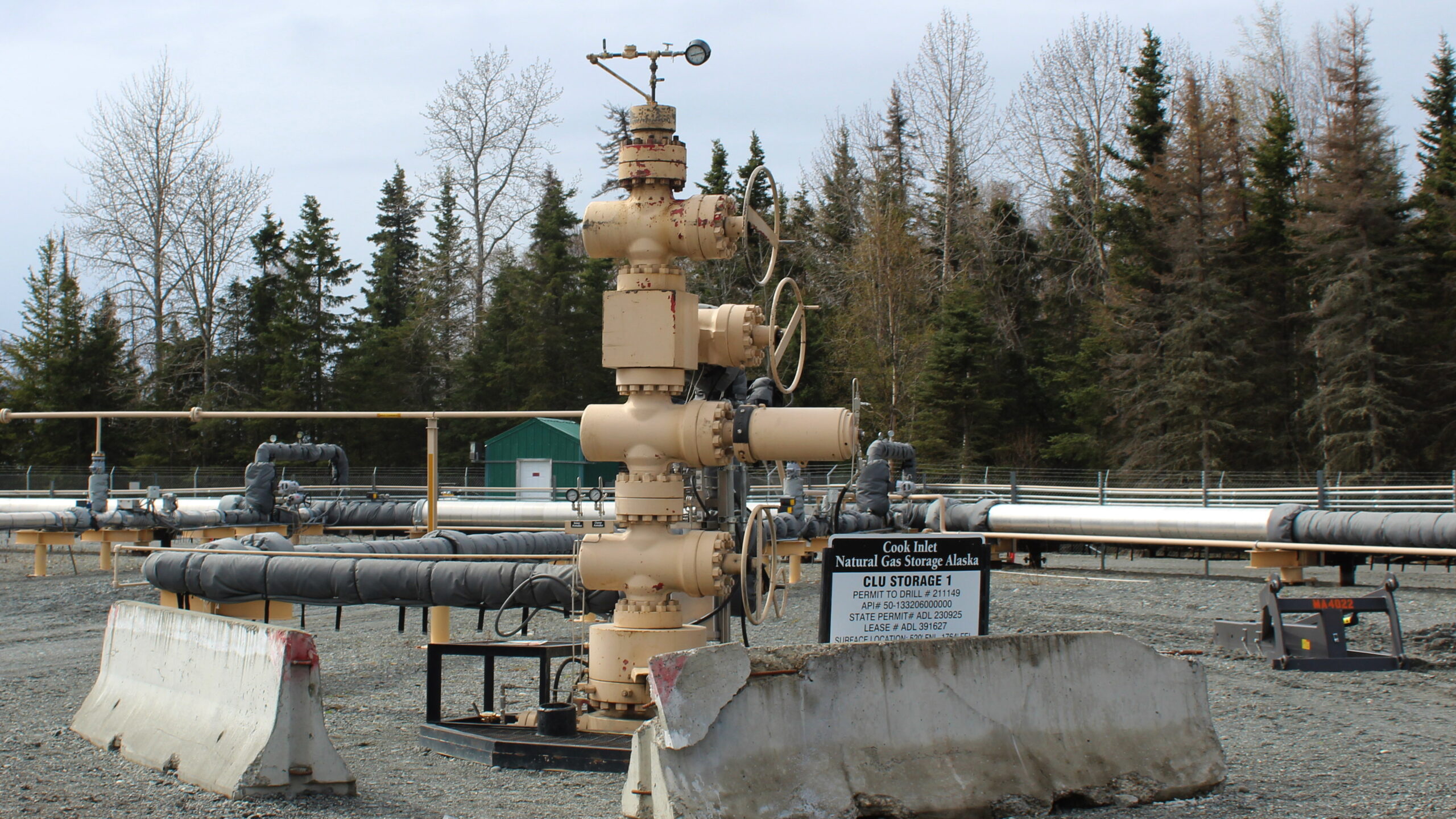
Alaska’s Department of Natural Resources says it favors a proposal from ENSTAR over Hilcorp’s to expand natural gas storage in Kenai. That recommendation is published Tuesday that analyzed competing proposals.
Read more Special committee identifies improvements for state-run Mt. Edgecumbe High School
But the city of Kenai said the report makes a key omission: that ownership of the storage space is contested. Kenai officials said that disagreement could derail expansion at a time when natural gas is already in short supply.
Haley Paine directs the department’s Division of Oil and Gas and wrote the report. She said the department considered the companies’ familiarity with the assets, proposed timelines and the ability to meet regional demands. But state law is a little vague on how to compare conflicting applications, Paine said.
“In the totality of all of those, ENSTAR presented the finding that we found to be in the state’s best interest,” she said.
Hilcorp was unable to comment before publication.
It’s been several months since ENSTAR and Hilcorp Alaska submitted dueling proposals to store natural gas in Kenai. At issue is access to pore space in a mostly empty gas reservoir. The so-called Kenai Loop Gas Field is part of the larger Tyonek Formation and sits partially under the Kenai airport, stretching under Walmart and north under Marathon Road.
Paine said ENSTAR’s application included a plan for cooperation with the existing lessee, AIX Energy LLC, and a “timely and feasible” development plan.
But the report doesn’t just identify the state’s preferred proposal. It also asserts partial state ownership of the subsurface pore space. The department says the federal government conveyed the subsurface rights to the state in the mid-1980s. Then the state leased the land to AIX in 2007 for natural gas extraction. Cook Inlet Region Inc. and the Alaska Mental Health Trust also own mineral estates in the Kenai Loop field.
But Kenai said it owns the reservoir pore space — and that an outside lawyer agrees. In an Oct. 7 letter to DNR Commissioner John Crowther, Kenai city Manager Terry Eubank wrote that the city and DNR are at an impasse on the question of ownership. In its opinion, Pioneer Law LLC argues Kenai owns the pore space, while the state only owns the gas that used to be in the pore space.
In a statement to KDLL, Eubank said he is “disappointed” the state report doesn’t address that conflict.
“The omission of disputed ownership in the preliminary recommendation is misleading and detrimental to an ongoing process to resolve the dispute without litigation or project delays,” Eubank wrote.
Eubank said the city has diligently reviewed the companies’ lease applications and is committed to advancing a gas storage project that also serves the interests of city residents.
“There is a very real possibility that both will issue conflicting leases (potentially to different applicants) that will result in lengthy and expensive litigation and delay the supply of additional gas to South Central,” Eubank wrote in the letter.
Read more The risk from landslide tsunamis is intensifying in busy Alaska fjords, with no plan in place
The department’s recommendation comes as Southcentral utilities prepare for natural gas demand to outpace supply. ENSTAR has said it could fall 18 days short of supply this winter, depending on temperatures. And this week, the Interior’s Golden Valley Electric Association told customers to prepare for rolling blackouts if demand spikes.
When ultracold temperatures send customers turning up their thermostats, companies can draw from gas storage to replenish supply. In the Cook Inlet region, there are just two other storage facilities. Both are in Kenai and have a combined storage capacity of around 52 billion cubic feet.
But only the Cook Inlet Natural Gas Storage Alaska facility, or CINGSA, offers third-party gas storage. When it opened in 2012, it was Alaska’s first commercial natural gas storage facility. CINGSA and ENSTAR have the same parent company.
In her preliminary decision, Paine said enabling more storage will reduce the burden on those other facilities. In 2024, for example, two of CINGSA’s wells failed, straining the rest of the facility.
DNR said the Kenai Loop field used to hold around 32.5 billion cubic feet of gas. It estimates there’s about 4 billion cubic feet still in the formation. The companies must reserve some of the space for a buffer, but believe they could store around 17 billion cubic feet of extractable gas. That’s equal to about a quarter of Southcentral’s average annual gas demand.
ENSTAR faced a setback earlier this year when the Regulatory Commission of Alaska denied a petition from the utility that would have helped unlock financing for the project. ENSTAR appealed that denial.
On Thursday, ENSTAR spokesperson Harley Hedlund said the utility appreciates the department’s recognition of the importance of more natural gas storage.
“ENSTAR will continue working with DNR as it considers public comments and any additional information before issuing its final finding and decision,” Hedlund said.
The recommendation kicks off a monthlong public input period. The department will incorporate the feedback it receives into its final recommendation, Paine said. Then the department will decide whether to issue the lease.
Public comments can be emailed to [email protected]. Comments can also be mailed to Best Interest Findings at 500 W. 7th Ave., Suite 1100, Anchorage, AK 99501.
Read more Republican Treg Taylor refuses Trump’s call to exit Alaska governor’s race
Copyright 2026 KDLL