
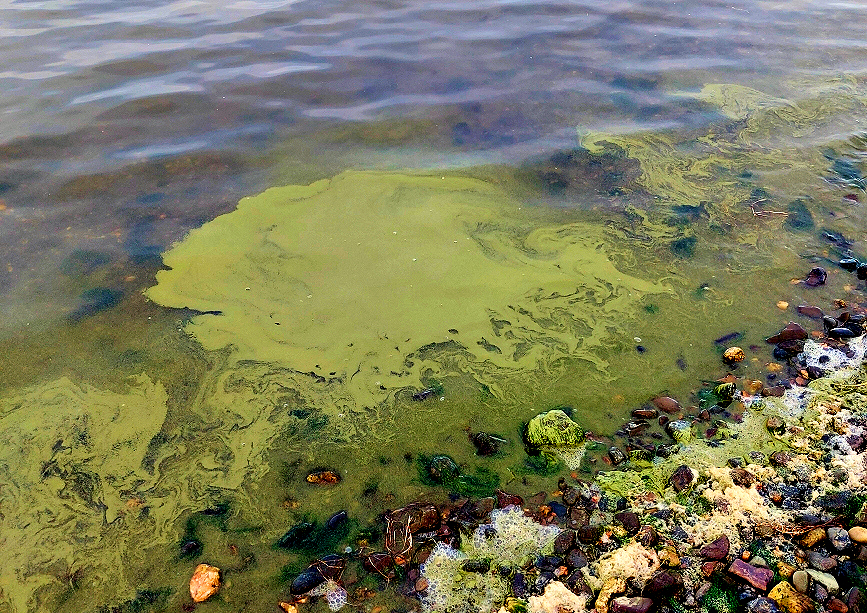
Algae is vital to a healthy marine system, and most of the hundreds of varieties in Alaska’s waters are beneficial or benign.
Read more GCI customers in Aleutians connected to satellite while waiting for fiber cable repairs
But the handful that are harmful are, like other algae, proliferating in warmer conditions and releasing or threatening to release toxins that can sicken people and wildlife and, in the worst cases, cause deaths.
The best-known type of algae that poses risks to people, mammals and birds in Alaska is called Alexandrium. The toxins it produces cause paralytic shellfish poisoning; they block the delivery of sodium to cells, thus interfering with or shutting down nerves essential to bodily functions.
The most potent Alexandrium toxin is saxitoxin, but there are related toxins produced by the same algae called gonyautoxins, or GTX. Some GTX varieties, including one detected in tomcod harvested in December by Nome-Beltz High School students in a yearslong science project, are nearly as toxic as saxitoxin. For simplicity’s sake, testing for paralytic toxins often lumps measurements of saxitoxin and GTX compounds together as “saxitoxin equivalent,” said Thomas Farrugia, coordinator of the Alaska Harmful Algal Bloom network.
Like other algal toxins, Alexandrium toxins cannot be cooked or frozen away. There is no antidote for people afflicted by paralytic shellfish poisoning. People who recover do so after the toxin passes through their bodies. In fatal cases, people stop breathing.
There were of paralytic shellfish poisoning and five fatalities in Alaska between 1993 and 2021, a tally that does not include mild cases for which there was no medical treatment provided, according to state health officials.
In addition to posing risks to people who eat shellfish, saxitoxin and saxitoxin-like products of Alexandrium can poison wildlife. The toxin might have been a factor in bird die-offs in recent years, including the 2015-2017 event known as the “wreck” that wiped out an estimated 4 million common murres during the intense marine heatwave known as the “Blob.” It is now classified as the world’s largest wildlife die-off on record. Saxitoxin was determined to be the cause of death for northern fur seals found stranded on beaches in the Pribilof Islands in 2024 and 2025.
Traces of domoic acid, but no Alaska problems yet
There’s another algal threat on the horizon. Pseudo-nitzschia is another category of harmful algae of concern in Alaska.
Some varieties produce domoic acid, a toxin that is present in very small quantities in Alaska waters and Alaska animals. Its presence is so minute that it has not caused any trouble this far north. But domoic has wreaked havoc among marine mammal populations in California.
In contrast to saxitoxin and related toxins, which cause paralysis by blocking nerve transmissions, domoic acid overstimulates the nervous system. The resulting illness, called amnesic shellfish poisoning, causes victims to go into seizures and can result in permanent memory loss, brain damage and death.
Deaths to people have been extremely rare. The only recorded fatal human cases, according to scientific records, were four people who ate mussels in Canada’s Prince Edward Island in 1987.
But starting in 1998, domoic acid has been taking a heavy toll on marine mammals in California.
That year, a mass die-off of sea lions at Monterey Bay touched off alarms. Lefebvre, then a first-year graduate student who happened to be studying domoic acid, joined the investigation suggesting it could be the cause.
Other potential causes, such as mercury poisoning, were initially suggested before domoic acid was identified as the culprit. The toxin accumulates to high concentrations in small fish like sardines and anchovies, which California sea lions eat.
Hundreds of California sea lions died that year in the first documented marine mammal poisoning event caused by domoic acid. Since 1998, domoic acid-caused poisoning events in marine mammals occur annually in California, Lefebvre said.
“We have dozens to hundreds of sea lions every year dying from domoic acid poisoning,” she said. Other marine mammals can be poisoned as well, including seals, otters, dolphins, porpoises and whales. Symptoms are visible and include seizures, in which animals sway their heads and move their flippers, disorientation and erratic behavior. Large numbers of seabirds have also been killed by the toxin.
“It’s become a regular event in California that continues to increase in severity. I’m kind of uniquely poised to see these trends after being involved in the first documented marine mammal domoic acid poisoning investigation and having studied this phenomenon for nearly 30 years,” Lefevre said. She leads a surveillance program at NOAA’s Northwest Fisheries Science Center called the Wildlife Algal-toxin Research and Response Network (WARRN-West), which covers the North American West Coast from the Beaufort Sea to Southern California.
Domoic acid detections, sometimes in combination with detections of saxitoxin, have also prompted shellfish harvesting closures and restrictions along the West Coast. Earlier this year, the commercial harvest of Dungeness crab was delayed in one Northern California area because of domoic acid.
Domoic acid poisoning events have not been documented in Alaska, but low levels of the toxin have been detected.
Residents in the Kenai Peninsula’s Kachemak Bay area worried that last summer that they might have witnessed the first poisoning event. At the same time that elevated Pseudo-nitzschia levels were detected in the bay, there was a die-off of birds and sea otters.
Investigations by the Alaska Harmful Algal Bloom Network, the Homer-based Kachemak Bay National Estuarine Research Reserve, Seldovia Village Tribe and other partners turned up of domoic acid poisoning, despite the Pseudo-nitzschia bloom there. The deaths remain unexplained, despite the testing of 30 marine mammals and 14 birds, said Rose Masui of the Kachemak Bay National Estuarine Research Reserve.
Lefebvre, whose studies turned up trace levels of domoic acid in mammals ranging from sea lions in Southeast to bowhead whales in the Arctic, believes it will be a long time before Pseudo-nitzschia blooms becomes a serious danger in Alaska. Still, Kachemak Bay residents were smart to investigate it, she said.
“It’s something to be watching,” she said.
‘Terrible nature’ and fluorescent-colored waters
A third type of harmful algae of concern in Alaska is a collection in the genus Dinophysis. Those algae produce toxins that are not life-threatening, but cause a condition called “Diarrhetic Shellfish Poisoning.” The genus name itself hints at the unpleasant symptoms caused by the toxins; it derives from Greek words for “terrible” and “nature,” according to the U.S. National Office for Harmful Algal Blooms.
Dinophysis species are widely present in Alaska, as a series of showed. So far, there have not yet been any cases of Diarrhetic Shellfish Poisoning recorded in Alaska, according to the state Department of Health. However, blooms have prompted shellfish closures along the West Coast south of Alaska, including in Washington State.
A fourth type of organism with blooms that proliferate in warmer conditions is cyanobacteria. Despite being commonly dubbed “blue-green algae,” cyanobacteria are photosynthesizing bacteria and not actually any type of algal species.
There are thousands of identified types of cyanobacteria. The organisms are key building blocks to life on Earth. But certain types have their downsides.
Blooms can deplete dissolved oxygen levels in water and lead to mass fish die-offs. They can also produce toxins that can poison fish and wildlife and pose direct threats to people. Some strains in freshwater have been shown to produce saxitoxin, as studies from the Great Lakes and elsewhere have shown.
Cyanobacteria toxins can also irritate people’s skin and eyes, cause vomiting and diarrhea and, in the most serious cases, lead to organ damage or failure. In the Lower 48, warnings about blooms are regularly issued to swimmers, and beaches are occasionally closed.
Now cyanobacteria is a concern in Alaska’s far north.
Until 2008, cyanobacteria blooms were no problem in the Inupiat community of Kotzebue, which lies just north of the Bering Strait, above the Arctic Circle.
That year, the waters of Kotzebue Sound turned a weird, bright-green color.
“It was like fluorescent green paint,” said Alex Whiting, director of the local tribal government’s environmental program.
At first, people suspected that it was actually a spill of green paint or some other hazardous substance, he said. Even the Alaska Department of Environmental Conservation was stumped for a while, he said.
Eventually, the as the culprit.
Since then, the blooms have been regular occurrences in the region, Whiting said. They are affecting places like Kobuk Lake, which is an arm of Kotzebue Sound, and Selawik Lake, which lies inland from Kotzebue and the Baldwin Peninsula on which the community is located.
In partnership with Columbia University scientists, the Native Village of Kotzebue, the tribal government, has become the Alaska leader in cyanobacteria research in Alaska, Whiting said. “There’s nobody that has put as much effort in Alaska at this than the Native Village of Kotzebue,” he said.
The Kotzebue-Columbia research project is working to evaluate the risks that cyanobacteria blooms pose to subsistence foods and the environmental drivers that lead to those blooms. That means compiling evidence about its effects in the food chain. The project is also testing a system that could help monitor blooms.
The blooms cannot be prevented, but the hope is that people will be prepared should any ill effects result, Whiting said.
The most pressing concern is the potential of cascading effects on the ecosystem. Cyanobacteria blooms, in addition to killing fish directly through oxygen depletion, can displace the phytoplankton that fish need as food sources.
“If it becomes common enough and widespread enough, it can disrupt the environment and cause all kinds of issues,” he said.
No dramatic effects have been documented so far from the Kotzebue-area cyanobacteria blooms. A 2021 fish die-off was suspicious, but no evidence turned up to tie it to cyanobacteria, Whiting said.
For now, he said, it is understandable that Alexandrium, with its potentially acute effects, gets most of the attention when it comes to hazardous algal or algal-like blooms. Cyanobacteria and its chronic effects have been a bit overshadowed, he said. “Most people in Alaska don’t know that much about it.”
That could change in a big way.
“At some point, we might wake up and there might be 100,000 or 500,000 fish lying belly up in Kobuk Lake,” Whiting said.
Read more 3 things to watch as Alaska’s election filing deadline approaches