
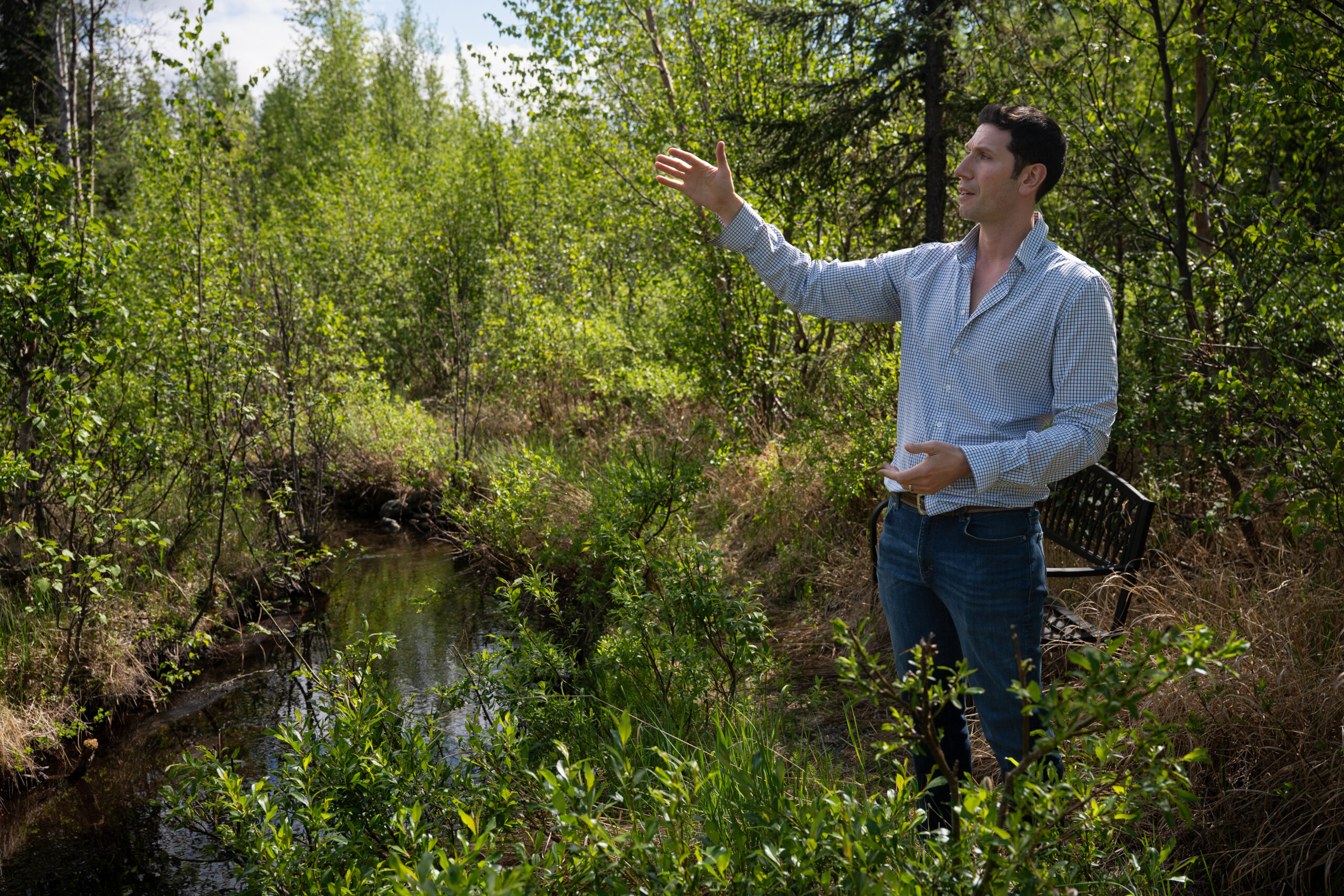
Danny Clift was looking for fish fry in the creek that runs behind his house. He bought the place in East Anchorage because of the wild military land that borders his back yard.
Read more Juneau Assembly addresses fairness issue regarding glacial outburst flood wall funding
“The idea of having my home back this nice, peaceful, serene creek, it made it feel very much like home,” he said.
Now, the military wants to build an 8-foot-tall fence topped with barbed wire along the edge of his property, right where that creek is.
“It’s really extreme. We’re talking about maybe 30 feet of ripping out all of the ground and all of the trees,” he said. “Taking all of the creeks that have natural wildlife passing through them right now, putting culverts in.”
He knew this kind of thing was a possibility when he moved in nearly a decade ago, but that doesn’t mean he likes the plan.
When most people think of Joint Base Elmendorf-Richardson, known locally as JBER, they think of the major military installations northwest of the Glenn Highway. But there’s a huge swath of military land that’s part of JBER southeast of the highway too. The new fence would go along the boundary between that part of JBER and residential neighborhoods in East Anchorage.
The fence is just one of many proposed security measures in a 574-page issued by the military. Others include a nearly one-mile long fence along the Glenn Highway and a short fence along Ship Creek near JBER’s Eagleglen Fitness Park. But residents and lawmakers have called for more time to review the proposal. And they want to better understand why increased security measures are necessary.
Daniel Volland is vice chair of the Anchorage Assembly.
“I think the magnitude of this project, being that it’s a seven mile fence that’s being proposed, I think it warrants further environmental review,” he said.
The Anchorage Assembly passed a resolution May 12 asking the military to extend the proposal’s comment period from 30 to 90 days. Volland was one of three sponsors.
This isn’t the first time the U.S. military has considered a perimeter fence. Two decades ago, the military proposed a 34-mile chain-link fence along JBER’s East Anchorage boundary. JBER eventually decided against it.
Read more Inflation tops 4% for the first time in 3 years on spike in gasoline prices
Rick Sinnott was the Anchorage area wildlife biologist for the state Department of Fish and Game at the time, and opposed the plan. In a written statement to JBER about the current plan, he said that such a fence could have significant environmental impact, such as preventing moose from traveling between calving and wintering areas. The fence would run through bear, moose, and wolf habitat. There would be some gates for recreation and wildlife, which would be closed during military exercises.
Anchorage’s current wildlife area biologist declined multiple interview requests.
Volland said his constituents who live near the base have questions about the proposal.
“What that might mean for moose movement, neighborhood access to recreation, quality of life, and also the aesthetics of potentially having a huge fence with barbed wire on the top in your backyard,” he said.
As the May 30 deadline approached, the military extended the comment period by just under two weeks. In a text message, Volland said he appreciates the “responsiveness to the community’s request for more time.” But, he said, he’s not sure why the base needs more security in the first place. He hasn’t gotten an explanation from the military. No one from JBER reached out to the assembly to discuss the proposal, he said.
Representatives from JBER declined multiple interview requests.
Anchorage residents have hiked and skied trails in parts of JBER for decades, but it requires a permit, and a check-in on the JBER website. Sometimes the area is closed because there are live-ammunition drills. The draft proposal states that the JBER border with East Anchorage is vulnerable because trespassers sometimes interrupt military training exercises, or enter places where “there is an increased potential for severe injury or death.”
Clift, who is the outgoing chair of the Scenic Foothills Community Council, said he’s heard from JBER officials in the past who are frustrated with civilians entering the military land when they shouldn’t. Clift said he gets that it’s a real problem.
“It is a recreational area back here, but they won’t sign into the website, and they won’t check to make sure that it’s open or closed,” he said.
But Clift doesn’t think the fence is the right fix.
“A better solution might be more signage, more knowledge,” he said. “Put the signs up so that people know where to log in and look at the website. That would be less catastrophic to this area.”
Read more 3 key takeaways from Juneau’s finalized city budget
The extended comment period closes June 12.