
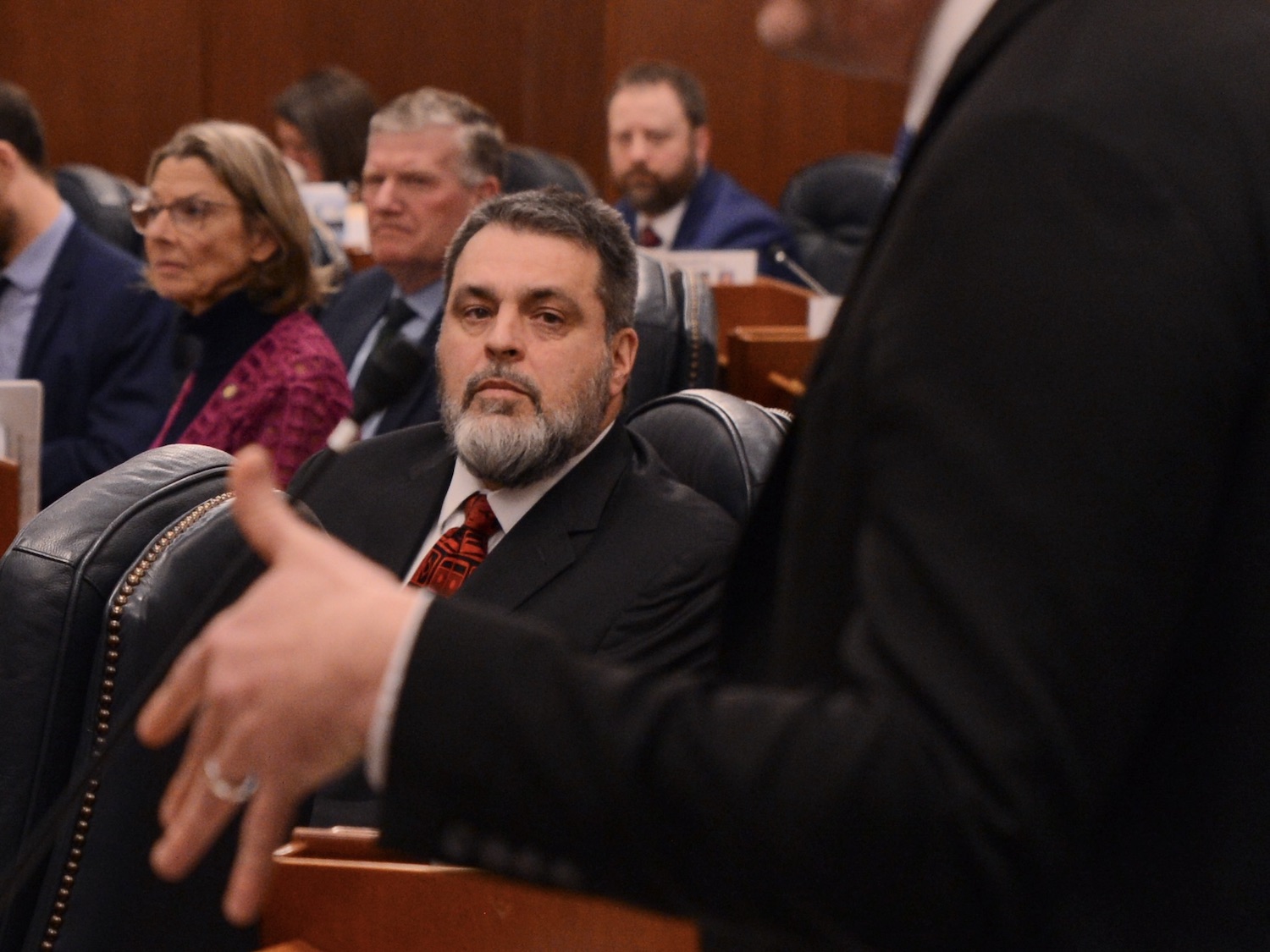
The 14 members of Alaska’s Senate coalition majority met behind closed doors twice on Wednesday to decide the fate of a multibillion-dollar tax break for the proposed trans-Alaska natural gas pipeline.
Read more The Anchorage Weekender: 19-plus hours of daylight, festive citywide celebrations and 3 roadtrips
The state House voted 34-5 on Friday to approve the break, which also has the approval of Gov. Mike Dunleavy and pipeline developer Glenfarne, but the tax break won’t become law unless it also has the approval of the Senate.
For several days, the Senate’s majority has been stymied by an internal rule that requires 11 of the majority’s 14 members to agree on a bill before it is presented to the full Senate.
As of Wednesday afternoon, there were not 11 majority votes for the bill, which would replace a 2% property tax on the project with a tax on gas pumped through the line.
Under current law, the pipeline would generate $47 billion for the state and boroughs along the route through 2062, according to figures from the Alaska Department of Revenue.
The House-passed bill would drop that figure to about $31 billion. The $16 billion difference is the result of the switch from a property tax to a gas tax. The state would still collect production taxes, royalties and other fees.
Lawmakers are also interested in lowering natural gas costs for Alaska residents. If built as planned, the pipeline would provide in-state gas to the Railbelt at a rate cheaper than imports.
In a newsletter, Sen. Loki Tobin, D-Anchorage, became the latest lawmaker to voice opposition to the House’s version of the bill.
“A 90% tax cut for Glenfarne raises concerns that our state and local governments may not have enough funds to support essential services such as sanitation, schools, and roads, which directly impact our communities and families,” she wrote in part, referring to the property tax cut.
Glenfarne has said the bill is critical in order to obtain financing for the Alaska LNG project, which would build an 807-mile pipeline from the North Slope to Cook Inlet and major processing plants at either end of the line.
Senators are considering amendments to the House bill that could ease the bill’s passage in the Senate, but Glenfarne has warned the Senate Finance Committee against making big changes.
“We’re encouraged by the House progress and strong outcome and are optimistic the Senate will pass a bill that works for Alaska by helping enable this project,” said Tim Fitzpatrick, a spokesperson for Glenfarne.
On Wednesday, the Senate majority canceled a scheduled meeting of the full Senate and two scheduled meetings of the Senate Finance Committee, which is considering changes to the bill.
Read more Crisis response teams free up Anchorage police and emergency services, officials say
The next meeting of the full Senate is scheduled for 11 a.m. Thursday.
Lawmakers are in a 30-day special session that ends at 11:59 p.m. Friday. If they don’t pass the tax-break bill by that deadline, the bill will die.
Dunleavy could call legislators into another special session, and while the governor’s office declined to say whether he is prepared to do so, the six members of the Senate’s all-Republican minority caucus said they have seen a draft special-session proclamation.
In separate interviews, all six said they support the House version of the bill, with only minor technical fixes needed.
Sen. Robb Myers, R-North Pole, said that while the pipeline isn’t guaranteed to happen if the bill passes, it’s guaranteed to happen if the bill doesn’t pass.
Sen. George Rauscher, R-Sutton, offered a similar position.
“Glenfarne has to have numbers that work, or they can’t build it. We can ask for anything we want — we can demand all the taxes — but in the end, if it isn’t built, we don’t get anything,” he said.
Senate Minority Leader Mike Cronk, R-Tok, called the majority’s 11-vote rule “pathetic.”
“We should all have the ability to cast a yes or no vote on this,” he said, noting that collectively, the minority’s six members represent more than 180,000 Alaskans.
Cronk said he believes the Senate will ultimately vote on the issue.
“I’m hoping we all get our chance to say yes or no. That’s what Alaskans expect. It shouldn’t be dictated by 11 people,” he said.
Cronk and Sen. Cathy Tilton, R-Wasilla, observed that the Senate Majority already broke its 11-vote rule during the regular session by calling up a pension bill, a medical licensing bill and a bill pertaining to gambling.
Despite Wednesday’s lack of action, Sen. Robert Yundt, R-Wasilla, remained optimistic, saying he believes the Senate will ultimately bring the pipeline issue to a vote.
“A majority of the state depends on natural gas. We’re either going to be using our own or importing, and when all is said and done, I think we’re going to be using our own,” he said.
Read more Sterling wildfire not fully contained but bounded, after multi-agency response