
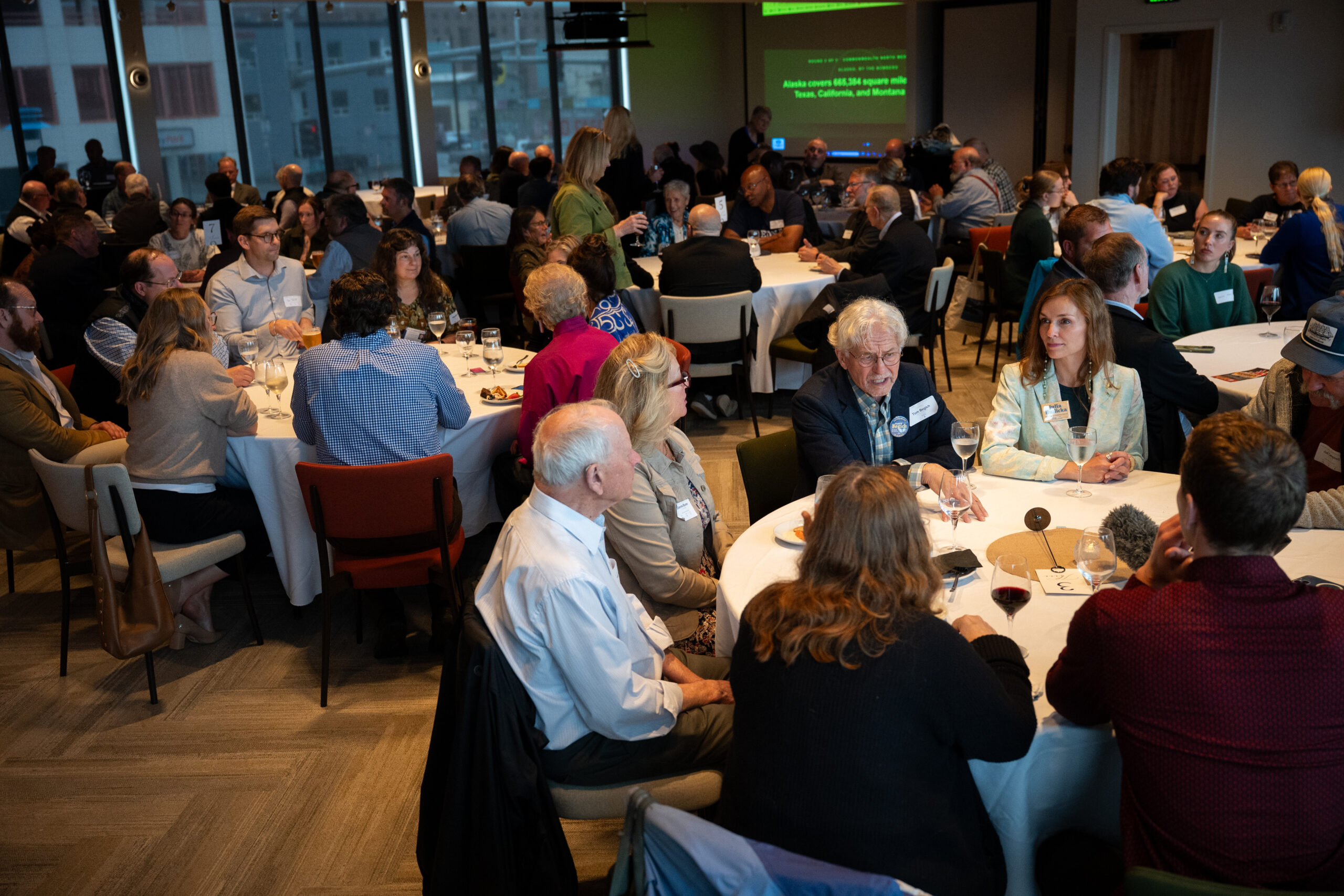
The crowd in the banquet hall of the downtown Anchorage hotel was mixed: suits and Xtratufs, young and old, gubernatorial candidates and voters.
Read more Anchorage Assembly censures one of its own for misuse of campaign funds
The sound of clinking china and chitchat mixed with string quartets covering pop songs. There were white tablecloths and appetizers and wine.
Former Anchorage School Board member Andy Holleman was sitting at a corner table eating chocolate chip cookies. He was there to ask candidates about education. He’s always been impressed by how accessible Alaska’s politicians are, he said.
“I mean, I’ve bought pasta from Senator Murkowski at her family’s pasta stand at a farmers market,” he said.
Less than a month before the primary, where the candidate field will narrow from 17 to four, the goal of the event was accessibility. It’s basically political speed dating. Each of the dozen participating candidates sat at their designated tables, and groups of people cycled through, asking questions. Commonwealth North, a nonpartisan policy organization, put the event together. It was the first of many, the organizers said. And despite pouring rain and the $50 ticket, it was at capacity, with over a hundred people.
Lee Butterfield is a teacher at South High School in Anchorage. His top priority is a pension for public workers, he said. A lot of his students end up in public sector jobs in the lower 48, where there is a pension system, he said.
“I watch them leave,” he said. “A lot of them want to come home, but it’s not there. There’s no security to come back.”
He wants a chance to talk to the candidates face to face, he said. Politicians tell you what you want to hear, so it can be hard to make the right choice, he said. He doesn’t go by gut instinct.
“I’m going to ask as many questions as I can in order to try to get them to slip up somewhere,” he said.
Most people say they’re here to choose who they’ll vote for on August 19 during the open nonpartisan primary, where voters choose one candidate. But Bernie Smith already knows he’s voting for Bill Walker, an independent, like he has several times before. He’s here to figure out who to vote for in the general election, when the top four vote-getters move on, and voters rank them on the ballot.
One of Smith’s top priorities is the ability to work across party lines, he said.
“There are people fighting and fighting and fighting, and we don’t need that,” he said. “We’re Alaskans, we don’t need to be fighting each other.”
When the room was full, Ross Johnston, executive director of Commonwealth North, took the mic and explained strict rules: no monopolizing the conversation, no follow-up questions and no statements wearing a “question costume.”
Guests and candidates found their tables, and the candidates introduced themselves.
All around the room, people started asking questions.
Republican candidate Dave Bronson moved from a conversation about the need for more natural gas to talk about sustaining the Permanent Fund Dividend.
At Democratic candidate Tom Begich’s table, voters asked about ways to improve education. Begich said he was unsurprised by the questions he was getting.
Read more Sen. Murkowski’s ‘landless’ bill advances to U.S. Senate floor
“These are the questions people are asking all over the state,” he said. “They’re asking about education. They’re asking about how we’re going to fund this. They’re talking about energy.”
Republican candidate Bernadette Wilson finished up a discussion about trawling. The topics didn’t surprise her either, she said.
“It’s the same questions we’ve been asking governor candidates for 10, 20 and 30 years, right?” she said.
But Tarn Coffey had something different for Democratic candidate Jonathon Kreiss-Tomkins. A simple question, he said.
“So, I’m a farmer,” he said. “That’s what I do. Grow things. What is the plan to address that agriculture’s been underrepresented?”
Kreiss-Tomkins answered with a question: “What are the factors that are holding back agriculture in Alaska?” He admitted he needs to learn more about the issue. It’s not his background, like fisheries, he said.
“Farmed…fish?” a man offered from across the table, winking.
Kreiss-Thompkins responded in mock horror.
“I’m gonna not take note of that heresy,” he said, laughing.
After an hour or so of cycling between tables, refilling wine and steady chatter, the main event was over.
But people clustered together, continuing conversations.
Sean Williams still didn’t know who he was going to vote for.
“You know it’s early,” he said. “So I’ve got time to torture myself over the overthinking.”
There are issues he really cares about, he said. But strategy is important, he said, because he wants to vote for someone who can win. Likability is a big part of that, he said.
“You have to have the sizzle,” he said. “If you don’t have the sizzle, you’re not going to win.”
Christine Hopkins said the event helped her narrow down top contenders. Not many candidates gave her straight answers, she said.
She said she heard the same thing from most of them: “Let’s get Alaska back on track, think about future generations.”
“They’re all saying that,” she said. “But what does that mean, and how are they going to solve that?”
The banquet hall emptied out, but Republican candidate Adam Crum was still chatting by the door. He said he appreciated having time to go in depth with people on so many topics.
“You’ve got groups across the board addressing questions about Alaska, and that is important,” he said. “That is a dialog that must never end. If we ever stop talking, then we are in a tremendous amount of trouble.”
Read more The Anchorage Weekender: Salmon slaying, a wine walk and 9 more local events