
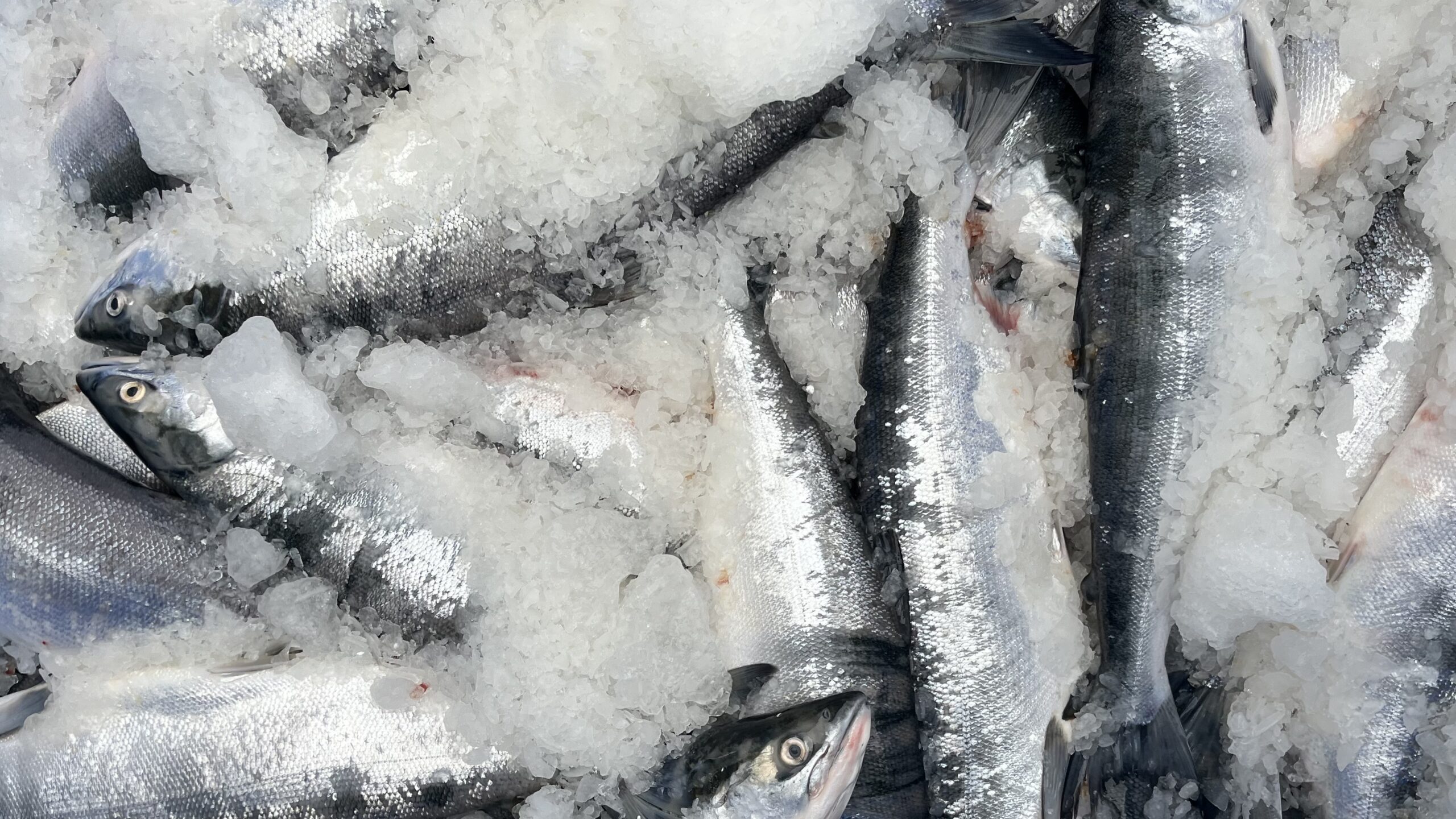
Bristol Bay’s sockeye salmon run is coming to a close, and it just surpassed the Alaska Department of Fish and Game’s pre-season forecast of 44 million fish.
Read more Can the U.S. and Iran take the off-ramp?
The thing that stands out most this year was that early run timing, said Curry Cunningham, an associate professor at the University of Alaska Fairbanks and part of a team that creates pre-season and in-season forecasts for the commercial fishery.
“If we look at the large-run-size years in Bristol Bay, we’ve seen generally since about 2015 they’ve been predominantly on time,” Cunningham said.
The last two years have bucked that trend, he said.
“In 2025 and this year in 2026, we’ve seen earlier run timing to Bristol Bay,” he said. “So a bit of a shift back towards run timings we hadn’t seen in quite a while.”
One of the variables that correlates most strongly with run timing is the extent of sea ice in the late spring, Cunningham said. Bristol Bay sockeye tend to return earlier during years with more sea ice in May.
This year’s run was about three days earlier than the long-term average, according to Cunningham, with a midpoint around July 3 or 4. While three days might seem like a small difference, he said it can have big impacts.
“In Bristol Bay, where the vast majority of the run comes through and arrives inshore over the course of two or three weeks, it actually makes a huge difference,” he said.
Both state and university biologists in the bay said that three-day early run timing stands out as a defining feature of the season, along with big returns in the Egegik and Ugashik Rivers, a perfect storm of king salmon closures and early run timing in the Nushagak District, plus the smallest Naknek River run since 1998.
Overall, catch and escapement counts balanced out to come in just above Fish and Game’s pre-season forecast of a 44 million-fish inshore run. That’s about 7 million fish above the average total run dating back to 1963.
But the last decade in Bristol Bay has seen historically large sockeye returns. That means this year’s more moderate run is well below the average of the last decade.
Over on the east side of Bristol Bay, Egegik and Ugashik River runs came in above forecast.
Stacy Vega is the Fish and Game management biologist for those districts.
“Egegik has come in about 2 million over forecasts, which is wonderful, and Ugashik is about a million and a half over at this point,” she said. “Catch forecasts have been exceeded, as well as escapement.”
Vega said in Egegik that’s largely due to strong representation in each age class of salmon, following years of favorable freshwater and saltwater conditions.
What was most unusual, though, was Ugashik’s run timing, she said.
“Ugashik specifically was extremely early,” said Vega. “It was (a) pretty vast departure from normal run timing, about a week early from average, which kind of complicates management.”
On the west side of the bay, the Nushagak District’s rivers also experienced early run timing this season.
Read more Alaska Democratic U.S. House candidate says he had support but not enough money
Tim Sands, the area management biologist for the Nushagak District, said the midpoint of the run in his district was around July 1, which is about 3 days earlier than average.
But this season, the start of commercial sockeye fishing was delayed until June 27 to allow more opportunity for upriver escapement of Nushagak king salmon, which historically return earlier than sockeye. The species was first listed as a stock of concern in 2022.
“We’re (at) about 35,000 king salmon counted at the sonar,” he said. “Still well below the 55,000 minimum that we want.”
Sands said that between the early sockeye return in the Nushagak and a delayed commercial opening to increase king counts, a lot of fish went upstream as escapement. That meant lower harvest rates than many fishermen hoped for.
Additionally, the sockeye run came in under forecast there. He said the run is essentially over at this point, now just over 15 million fish. That’s a few million short of the forecasted run of 19 million fish, and reflected in the Nushagak’s harvest, which is about 9 million fish so far, well under the forecasted harvest of nearly 14 million fish.
“We did what we could to try and provide balance between protecting kings and still not just shutting down the fishery completely,” Sands said.
For the Naknek River, District Management Biologist Travis Elison said this year’s run was the smallest in nearly 30 years.
“The Naknek came in below what we forecasted, and it’s actually probably the smallest run since 1998,” he said. “But the Kvichak came in above expectations and seemed to make up that difference for the total run size.”
He said the Naknek-Kvichak district’s catch this season is about half the average of what it has seen over the last 12 years, and that was reflected in the season’s fishing effort. Elison said in the early season, the districts only fished about one tide a day, even taking a few days off, to try to meet the Naknek River’s minimum escapement goal.
The smaller run is likely because of a few years of record breaking escapement from 2019 to 2021, he said. Big escapement can reduce productivity in the lakes when there are more fish competing for limited resources.
“I think we’ll be starting to get away from that and hopefully seeing some bigger runs for the Naknek here in the near future,” Elison said.
While this season’s returns and catches felt low for many folks out fishing, Elison said runs are returning to averages after record highs.
“We’ve just gone through 12 years of pretty much the biggest production in Bristol Bay history,” he said. “And now we’re back towards more of a historical average run size.”
However, the season’s more moderate run also comes with a higher price for sockeye than the last few years. At the beginning of the season, Silver Bay Seafoods announced a base price of $1.60 per pound.
Read more Former Anchorage Assembly member dies in Sterling Highway crash
Copyright 2026 KDLG 670AM