
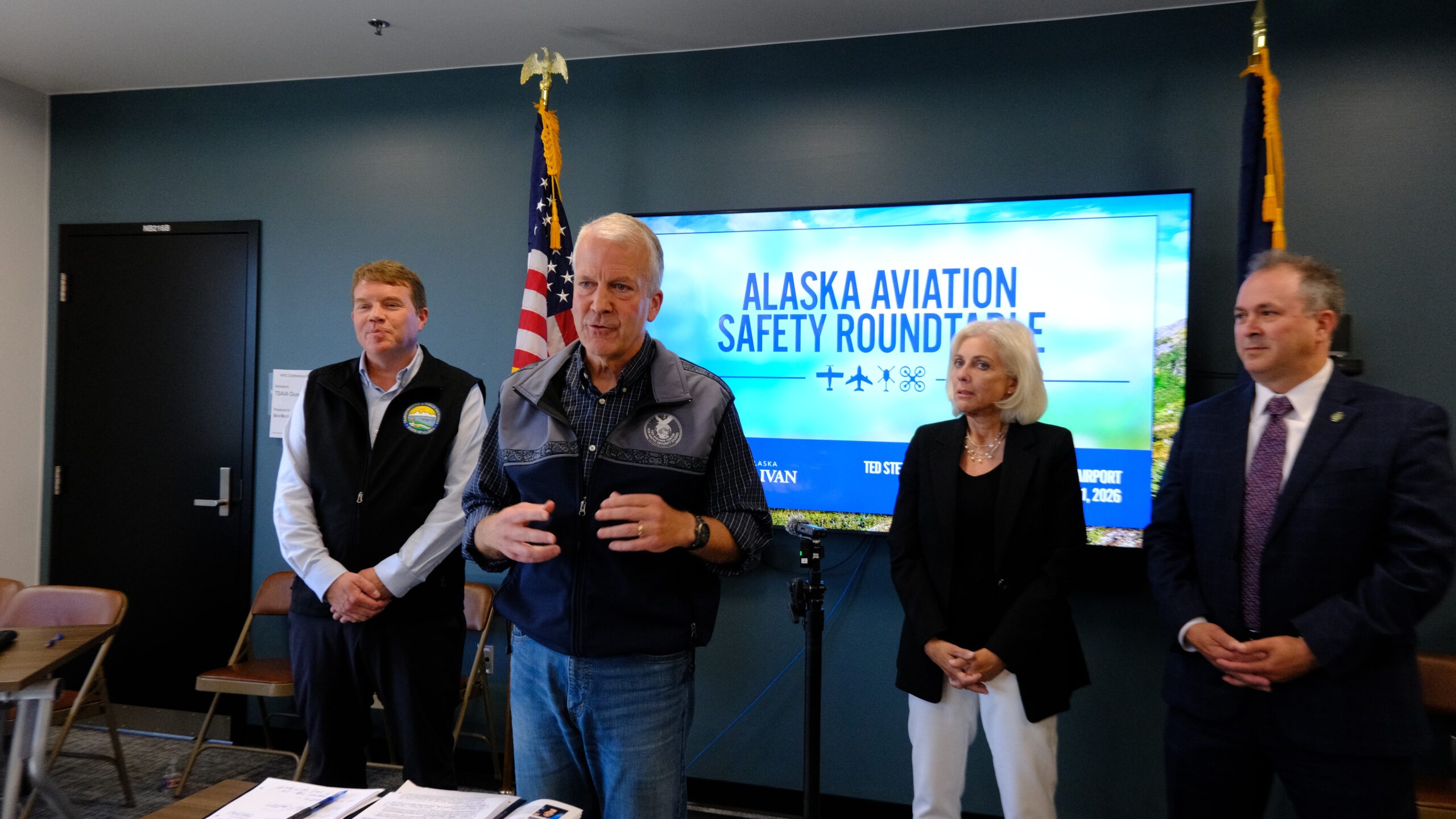
Alaska aviation experts and air carriers pushed state and federal officials to improve and maintain existing weather stations — rather than focusing on building new infrastructure — at an aviation safety summit hosted in Anchorage on Friday.
Read more A women’s pro wrestling troupe in Fairbanks rings in 10 years of bodyslams and bruises
Several dozen representatives from air carriers and associations from across Alaska participated in the summit.
Sen. Dan Sullivan led the roundtable and pointed to the state’s high rate of plane crashes and related fatalities. He said weather stations that report current conditions are crucial in Alaska, and while the state plans to build more than 150 new weather stations, local air carriers are frustrated they often can’t use the ones the state already has.
“We are getting infrastructure, weather systems in particular, throughout the state,” Sullivan said. “That’s great, but one of the outcomes of this summit is we currently have weather systems and aviation lighting and things in rural communities that it takes months – and to be honest, in certain cases even years – to fix. That’s unacceptable.”
Earlier this week, a widespread outage affected dozens of weather stations across the state. Industry experts say that on any given day, up to 20 existing stations in Alaska are not reporting.
Sullivan said one idea that came out of the discussion was to contract local transportation staff to fix those stations instead of waiting for Federal Aviation Administration staff from out of state. Another idea was to create a spare part depot in Alaska to speed up fixing stations.
Sullivan said stakeholders also spoke about creating a better way to communicate issues and outages to the FAA.
Participants also brought up the status of flight service stations, which pilots also rely on for information about weather and runway conditions and for emergency assistance. Right now, at least four of Alaska’s flight service stations are closed, and more are operating at limited capacity after the FAA placed employees at those stations on administrative leave.
Read more Reporter examines impacts of ex-Typhoon Halong on youth mental health
Sullivan acknowledged the burden it placed on the hub station to take on those stations’ workloads.
Jennifer Homendy, the National Transportation Safety Board chairwoman, said flight station closures are a safety concern for pilots who rely on them, especially when weather infrastructure is not reporting.
“We do need those back up and running,” Homendy said. “The answer is not to close it, the answer is to fix it. Bring somebody else in, then, and continue to provide that service, which is a lifeline to pilots that are operating right here in Alaska.”
Regional FAA Director Eric Amend said at the meeting that the affected stations will remain closed for the immediate future. He said the agency is looking at several options to provide redundancy in services, but nothing has been decided.
The roundtable happened a day after the NTSB released a final report on the deadly 2025 Bering Air plane crash. The agency issued recommendations for the carriers and the FAA in its report including training for pilots to recover from a stall and improving safeguards to make sure they have necessary safety protocols as they expand operations. Homendy said many of the NTSB recommendations have been issued before.
“At what point is it enough people died to take action?” Homendy said. “I would urge FAA to take the recommendations that we issued yesterday seriously, because we don’t want to be here again reissuing them.”