
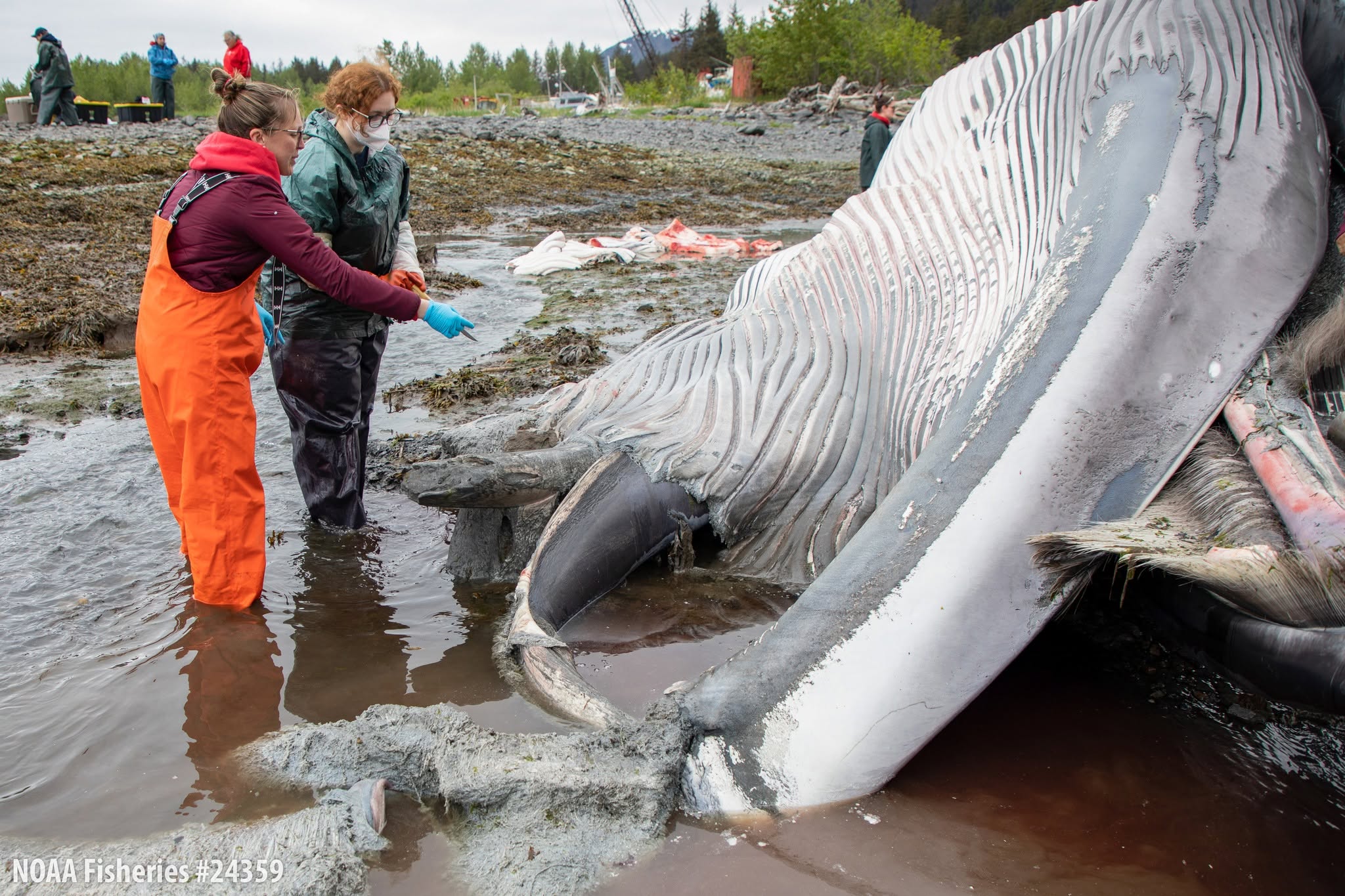
The pregnant dead fin whale found attached to the bow of a cruise ship that arrived in Seward on Friday likely died from a vessel strike. Biologists completed the preliminary necropsy over the weekend, announcing their findings Tuesday afternoon.
Read more High PSP toxin levels mean it’s ‘not a good time’ to harvest shellfish in parts of Southeast Alaska
The official cause of death is pending further testing.
The examination was conducted in collaboration with the Alaska SeaLife Center and Alaska Veterinary Pathology Services. Marine biologists found that the pregnant 61-foot adult whale was freshly dead, and in good nutritional condition, the statement said.
“Preliminary necropsy findings showed blunt force trauma to the jaw, spine and ribs consistent with a vessel strike,” NOAA Fisheries said.
Plans are currently underway to arrange for the whale carcass to be towed out to sea, where it is expected to “sink and nourish a wide variety of deep-sea marine life,” NOAA Fisheries said.
Samples and data collected from the dead whale will contribute to broader research that advances “understanding of Alaska’s marine ecosystems,” the Alaska SeaLife Center said in a statement.
The cruise ship involved in the incident, Ovation of the Seas, is operated by Royal Caribbean Group. The 14-deck vessel can hold more than 4,000 passengers.
In an emailed statement Wednesday, a company spokesperson wrote, “We are deeply saddened by the whale incident involving one of our ships en route to Seward and take any impact to marine life with the utmost seriousness.”
The spokesperson added that the cruise company is “cooperating fully with the NOAA, and we will partner with them following their final investigative findings.”
Read more Alaska Supreme Court denies emergency petition to force officials to open Fairbanks charter school
Fin whales are listed as endangered under the Endangered Species Act. The whales are one of the largest animals on earth, second only to the blue whale. They weigh between 40 and 80 tons, are up to 85 feet long and can live up to 90 years.
Whale strikes are somewhat common in Alaska, causing severe and sometimes fatal injuries. The major threat to fin whales comes from vessel strikes, according to a NOAA overview of the species.
In a blog post on whale strikes, the Marine Mammal Commission, an independent government conservation agency, said that several options can help reduce the risk of strikes. These include traffic separation schemes and routing measures, designating areas to avoid and lowering cruising speed limits.
The commission said that studies have shown that 10-knot speed limits are the most effective in reducing risk of vessel strike mortality and serious injury of large whales.
According to Royal Caribbean, its cruise ships average about 18 to 20 knots depending on the ship and itinerary.
A decade ago, a Holland America vessel arrived in the Resurrection Bay town with a dead fin whale on its bow. In November 2024, a fin whale the size of a school bus washed up along Anchorage’s busy Tony Knowles Coastal Trail.
Additional testing to determine the official cause of death of the fin whale can take months to complete, NOAA Fisheries said.
Read more Alaska charities can now host snowfall betting pools