
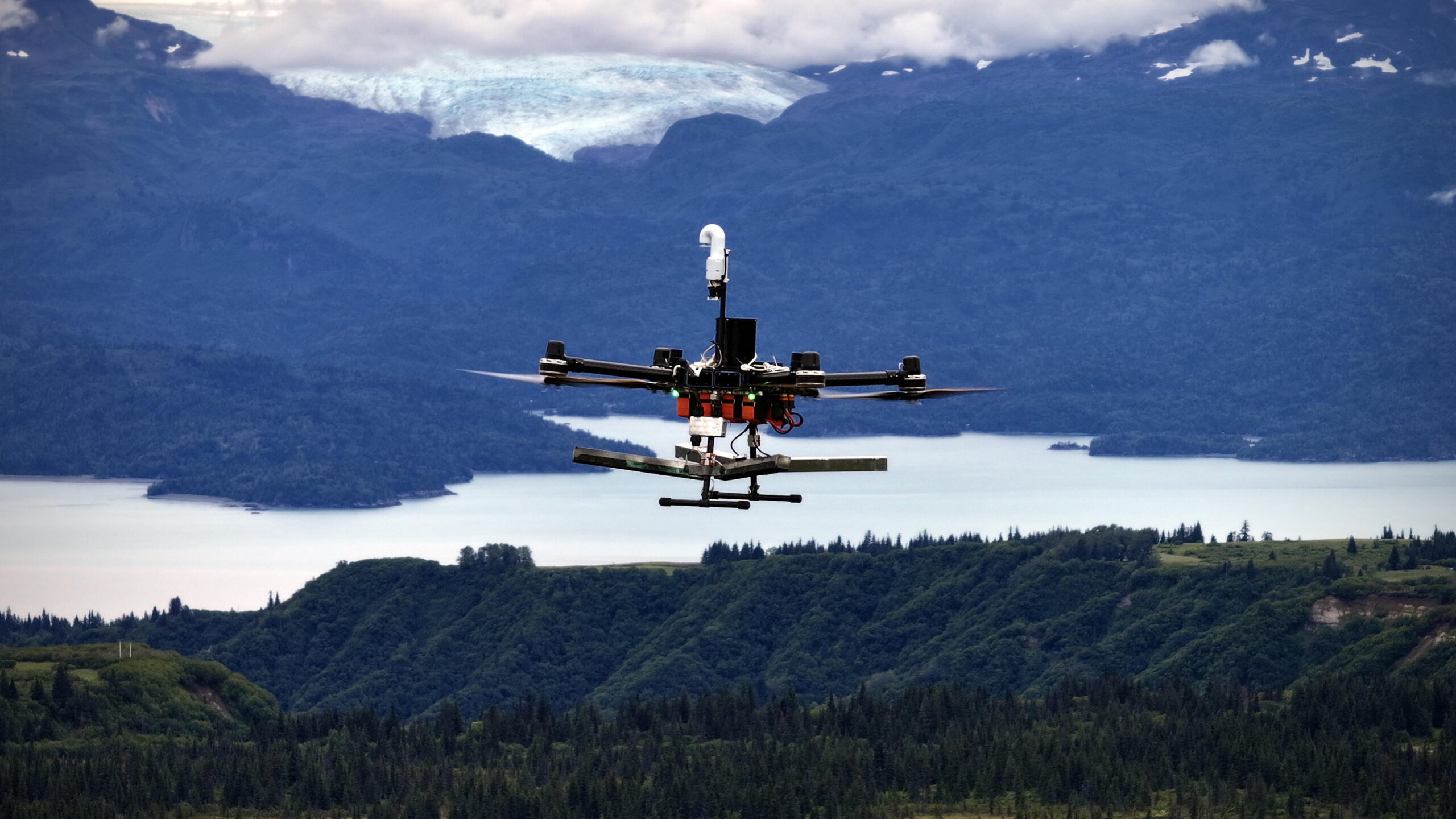
The Kenai Peninsula Borough Assembly advanced two pieces of legislation Tuesday that target weather modification. Both were introduced in response to a private cloud-seeding operation conducted near Homer last month that caught locals by surprise.
Read more 2 die in plane crash departing moose camp near Aniak
The company said it received necessary permission to make rain with drones, but local officials are pushing for more transparency.
Borough Mayor Peter Micciche is not afraid of cloud-seeding, he said. But the Kenai Peninsula should not have been Rainmaker Technology Corporation’s guinea pig, he said.
“No one knew what was going to occur prior to it occurring, and you know it’s a little fascinating to me,” Micciche said. “I guess the way that I boil it down in a nutshell is I did not have the opportunity to represent our constituents on them having knowledge about a material being released.”
The material released was silver iodide, which Rainmaker Technology Corporation dispersed over the southern Kenai Peninsula last month. It was part of a test of the company’s cloud-seeding technology and created one-hundredth of one inch of rain. The company said the experiment was successful.
Rainmaker envisions using drones to end water scarcity. Its product is predictable, short-term precipitation deployed in a way that restores ecosystems, enhances snowpacks and prevents wildfires. The drones disperse silver iodide into cold clouds, which catalyze ice crystals until those crystals are large enough to fall as rain.
The company said Alaska, and the southern Kenai Peninsula specifically, were a good candidate for testing the technology because it has cool clouds year-round – even in late August, when the company conducted its test.
Because the drones flew over state, and not borough, land, Rainmaker didn’t need borough permission for the test.
But Rainmaker CEO Augustus Doricko acknowledges the company could have done more local outreach before launching their drones. He’s a 26-year-old UC Berkeley drop out who sported a mullet and sherpa-lined jean jacket during an interview with KDLL on Monday.
“The point’s well taken that we could have informed the Kenai Borough and and the mayor and other parties earlier, but we did explicitly reach out to the Alaska Department of Natural Resources to get permission to get a letter of no objection to run both drone flights and cloud seeding operations over Alaska DNR land,” he said.
The company contacted the Ninilchik Natives Association and Cook Inlet Region Inc. beforehand anyway, Doricko said.
The state’s Department of Natural Resources signed off on the test in May, according to a letter shared with state lawmakers. State environmental officials said there isn’t a state law, regulation or permit program that outlines a protocol for cloud-seeding.
A Rainmaker spokesperson said Wednesday the company brought a 13-page proposal to the state before receiving DNR sign-off and never operated on Kenai Peninsula Borough land.
Micciche proposed two pieces of legislation.
The first, passed by the assembly, asks state lawmakers to outright ban, or at least regulate, weather modification and geoengineering. It asks federal lawmakers to strengthen federal law, too.
Read more Sullivan’s trawl bycatch bill clears a U.S. Senate committee
The borough already has an in-state ally in Homer Republican Rep. Sarah Vance. She’s been a vocal critic of Rainmaker’s south peninsula operation. She has already drafted a bill to introduce if reelected that’s aimed at establishing requirements for weather modification in Alaska that include local notification, Vance said.
“There was very little knowledge that they were going to be doing any type of cloud-seeding,” she said. “What we were told is that this was drone activity, research and development, and I didn’t have any answers confirming cloud-seeding until right before it became noticed in the public and by their social media posts and blogs.”
There’s some precedent for this. Doricko says 31 U.S. states have considered bills banning weather modification, but only two have passed legislation – Florida and Louisiana. And the federal Weather Modification Reporting Act of 1976 requires companies to inform the National Oceanic and Atmospheric Administration before modifying the weather, including cloud-seeding.
The second piece of legislation establishes a borough-specific permitting process for weather modification activities, including cloud-seeding.
The new section of borough code would define geoengineering and weather modification as the deliberate intervention in the earth’s climate system or atmosphere. Among other things, the permit application would need to include the type and amount of chemicals that would be used, the frequency of activities, predicted impact areas and total duration of associated flights.
If passed, the ordinance would take effect immediately. It’s up for a public hearing and final vote at the end of next month.
Public backlash to Rainmaker’s cloud-seeding operation has been swift, and multiple people weighed in Tuesday.
Carrie Harris, an Anchor Point hay farmer and candidate for state senate, said the borough should do everything it can to prevent weather modification.
“I’m asking you to use these powers now, and to please give a straight-up ban,” she said. “Don’t put language in there permitting it, because you might permit it on borough land, but it’s on my roof that it falls. It’s on my ground that my goats don’t get to eat on, and it’s on my dime.”
State environmental officials said there’s no evidence Rainmaker’s Kenai Peninsula operation “resulted in an adverse impact to human health or the environment.”
In all, Rainmaker drones released about 374.3 grams of silver iodide over the course of its test. The amount of silver iodide dispensed into clouds amounts to roughly a paperclip’s worth over hundreds of square miles at a time, Doricko said.
Although Rainmaker pitches itself as a drought solution, Doricko said he thinks the technology could be used in Alaska, too. He pointed to ice roads on the North Slope and augmenting snowpacks to protect glaciers. He says a world with weather modification is inevitable, and that he supports Alaska regulating the practice to enshrine prior consent, public notice and material safety.
Read more Houston man drank heavily prior to fatal shooting, charges say
Copyright 2026 KDLL