
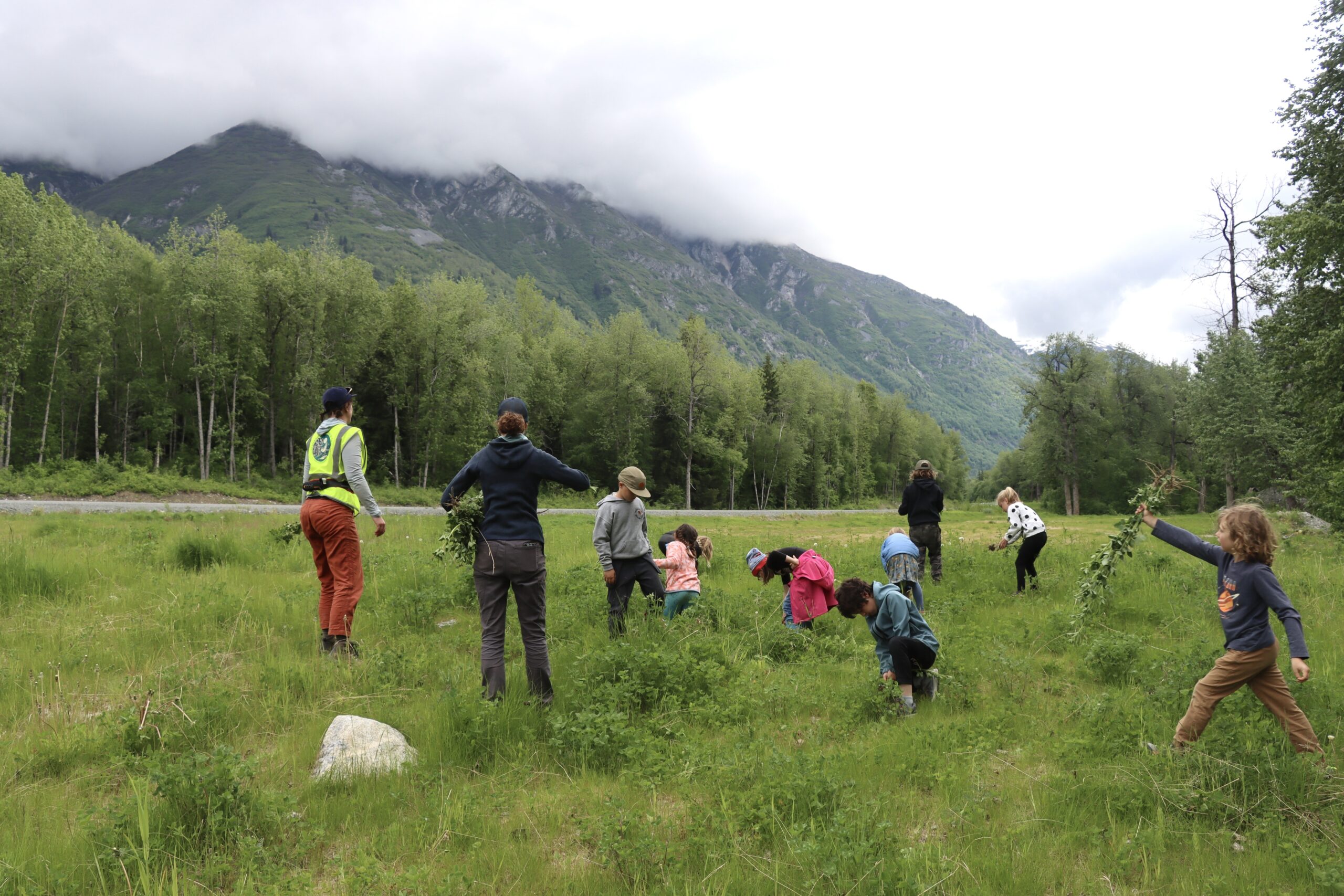
The Haines Highway is replete with wildlife, dramatic peaks and braided rivers. But stretches of the international roadway have recently been overcome by something else: an infestation of an invasive species known as white sweetclover.
Read more Subsistence battle leaves Alaska with $1.8 million legal bill
Conservation groups say its spread stems from a major highway project and could damage the local ecosystem.
“They can be harmful to the soil and other plants that are trying to live here. So we’re trying to pick them before they seed and make flowers,” Maren Billings, a local elementary school student, said earlier this month during a community pull day along the highway.
Billings was about 18 miles outside town, with other students in a nature-focused summer camp put on by the Takshanuk Watershed Council, a local nonprofit.
The kids were scrambling around a large field, pulling sweetclover at the roots. A few students over, Freyja Bailey dug her hands into the soil and yanked – grunting as the light green plant with serrated leaves came loose.
“The roots are really strong, and this one burrowed between rocks,” she said. “It’s a stubborn one.”
The point of the field trip was to help with a new, multi-year effort by Takshanuk and the Southeast Alaska Watershed Coalition to crack down on the sweetclover infestation before it spirals out of control. They have two or three years of funding from the Alaska Sustainable Salmon Fund and U.S. Forest Service.
The groups attributes the infestation to highway upgrades that started in 2018. It’s an Alaska State Department of Transportation project that received funding from the Federal Highway Administration.
An requires the state DOT to manage invasive plants on federally funded project sites, said Sonny Mauricio, an agency spokesperson.
“Our environmental analysts will survey each project and map out where we need to be addressed, and then we provide that information to the contractor who’s then required to develop a plan,” he said.
Matt Boron, DOT’s Haines foreman, said his crew does its best to cut brush along all DOT roads and avoid spreading invasives. But ultimately, he added, he lacks the resources to manage the problem more actively.
“A lot of the time we just have no budget or manpower to do something like that,” Boron said.
Stacie Evans, Takshanuk’s science director, pointed out at least one site where she said workers dug up sweetclover and buried them. But she said it’s crucial to revisit sites and continue taking care of them.
Read more Military agency prepares to exhume remains of unidentified WWII soldier in Sitka cemetery
“This infestation doesn’t look particularly managed to me,” Evans said while standing in a sprawling patch of the weed. “So we jumped in.”
Some of the plants in this area were already three feet tall. Later this summer, they’ll grow to be over five feet tall with “massive seed heads,” Evans said, each of which can distribute thousands of seeds.
Evans said the Chilkat Valley has historically had small sweetclover populations, but they really exploded around 2023. That was about midway through phase 2 of the highway project, which focused on upgrading the highway between miles 12.5 and 20.
Roadway construction often helps spread invasive species. That’s because it disturbs the soil, eliminates native species and creates sunny, open patches – sweetclovers’ paradise. But those aren’t the only contributing factors.
“If you look at some of the fill piles that DOT was using, you would see white sweet clover growing out of it,” Evans said. “So we know that the seeds are being distributed through the fill.”
She said that’s concerning because sweetclover can easily wipe out native species that are crucial for the broader ecosystem.
“It replaces that biodiversity with this monoculture and diminishes those ecosystem functions,” Evans said. “So it’s really not great for fish habitat, it’s become a problem in other parts of Alaska.”
Mauricio did not respond to follow-up questions about what steps have been taken to address invasives on the Haines project. Mauricio did say sweetclover is one of the toughest invasives to manage once it’s established, and that it’s common for nonprofits to get involved after road projects.
Asked for comment, a spokesperson for the project contractors – Secon and Southeast Roadbuilders – directed KHNS back to the state agency.
Evans, of Takshanuk, said a small crew of employees will be in the field four days a week pulling sweetclover and other invasives for the foreseeable future. But she also encouraged locals to pitch in and pull the plants, either with the crew or on their own time.
“There’s ways to get involved if people would like,” Evans said. “The more people we have involved, the better chance of success that we have.”
Read more Bill to protect youth in psychiatric hospitals dies after Dunleavy veto