
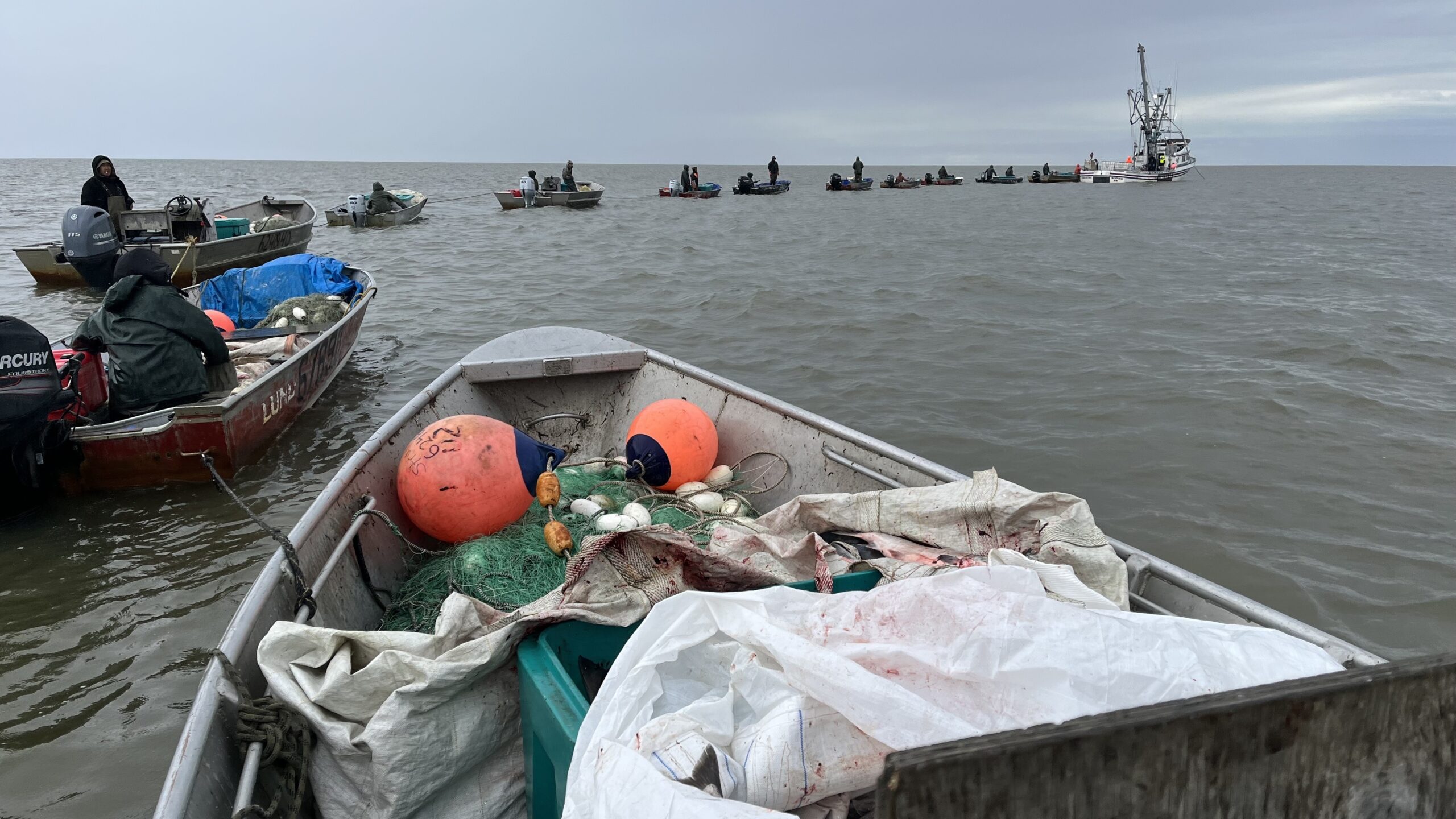
Dozens of ocean-going skiffs were busy unfurling gill nets along the shores of Kuskokwim Bay this summer.
Read more Alaska providers say childcare gap is growing
But the catches haven’t been headed to fish camps. Instead, the salmon are quickly bled, put on ice and offloaded onto vessels bobbing in the waters in front of Quinhagak and Goodnews Bay.
If the fishery is successful, an at-sea processor with hundreds of thousands of pounds of frozen, mostly sockeye salmon will return to Washington state to bring the catch to market.
According to Larry Strunk, a founding member of the Independent Fishermen of Quinhagak Cooperative, local permit holders could earn upwards of $15,000 each by fishing the openers.
“We have some fishermen that have already been paid over $10,000 this month,” Strunk said.
But by Tuesday, Strunk said, diminishing sockeye numbers and logistical issues had spelled the end of this year’s fishery, just three weeks after the Alaska Department of Fish and Game opened it.
Bringing back the commercial fishery after a five-year hiatus hadn’t been easy, Strunk said.
“It seems like nothing has gone easy this year, between financing, and water, and electrical, and finding the ice machines,” he said.
The processor also arrived a week and a half late, Strunk said. One of the tenders was also delayed, and the boat that delivers ice needed repairs after ex-typhoon Halong blew it across the river.
Still, Strunk said, the biggest challenge was financing. The fishery needed to generate at least $45,000 a day to cover the cooperative’s operating costs.
“We have to be able to catch enough fish to be able to break even, and at this point we’re still not there,” Strunk said.
The Quinhagak cooperative is on the hook for a $2.1 million loan from Coastal Villages Region Fund. In the past, the fund heavily subsidized the Kuskokwim Bay fishery. It built processing plants, first in Quinhagak, and later down the coast in Platinum. Both operated at a loss and shuttered operations.
The 2016 closure of the Platinum plant eliminated 150 jobs and left hundreds of local fishermen without a means of selling their catch. Then the Quinhagak cooperative was born.
“We wanted to actually be able to control our own destiny rather than be at the whim of somebody else,” Strunk said.
Read more Police identify man discovered in chest freezer at Juneau home
Shortly after forming, the cooperative put the pieces in place to bring back the fishery. In 2020, the cooperative made good on its agreement to deliver at least a million pounds of salmon to Seattle-based E&E Foods. But in 2021, the catch fell short of the million-pound guarantee.
The fishery floundered in the following years. A lack of available processor vessels, a market glutted with Bristol Bay salmon and serious conservation concerns for adjacent Kuskokwim River chinook and chum salmon all played a part, Strunk said.
‘New money’
This year, around 70 permit holders have been fishing Kuskokwim Bay. It’s just a fraction of the more than 700 Kuskokwim-area permits that once powered a lucrative salmon fishery stretching upriver to the hub of Bethel.
“Our goal has been in limiting the number of permit holders that can come in, so that a person can still make a living and pay for their gas, and pay for their motor and have a little bit of money in their pocket at the end of the season,” Strunk said.
Strunk, a retired, non-Native schoolteacher who married into a Yup’ik family in Quinhagak, has commercially fished for decades in the area. This summer, he’s been out on the water in his 22-foot skiff fishing with his son. But he said that most of his time is spent dealing with paperwork and finding last-minute workarounds.
“The last thing I wanted to do was be a fisheries manager, but I’m kind of falling into it,” he said. “I had no idea how to write a fish ticket or to verify fish tickets and do all of that stuff.”
Strunk stressed that he’s just one piece in a team of like-minded Quinhagak residents who want to bring much-needed capital into the community through the fishery.
“Fishing is one of the ways to bring in new money. Other than selling gravel, which is a one-time deal or making wind energy, there’s not much else going,” Strunk said.
Some of the salmon caught this year is even being sold locally. On Monday, Bethel Community Services Foundation received 20,000 pounds of salmon via barge that it purchased for its food security efforts.
Quinhagak could be a model for other community-led cooperatives, Strunk said, adding that he sees potential with commercial halibut, as well. It’s something that would come with a whole new set of challenges, including working to get federal halibut quotas in the hands of local fishermen.
“There’s that potential, but you’ve got to be able to step through that door and work it,” Strunk said.
It’s still unclear whether this year’s salmon fishery will pencil out, or whether the Quinhagak cooperative’s ultimate goal of becoming self-sustaining will ever be realized.
Despite decades of setbacks, Strunk said the Kuskokwim Bay fishery remains a “labor of love.”
Read more 23 Alaska legislators ask state to restore voters wrongfully removed from the rolls
Copyright 2026 KYUK